Ahmedabad
(Head Office)Address : 506, 3rd EYE THREE (III), Opp. Induben Khakhrawala, Girish Cold Drink Cross Road, CG Road, Navrangpura, Ahmedabad, 380009.
Mobile : 8469231587 / 9586028957
E-mail: dics.upsc@gmail.com
Key Highlights & Summary
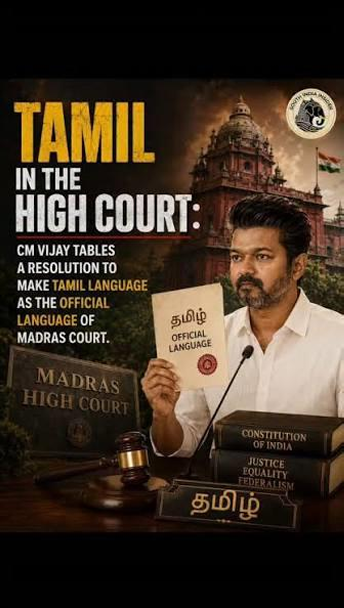
• Tamil Nadu Chief Minister moved a resolution in the Legislative Assembly urging the Union Government and the President to clear Tamil as the primary language of the Madras High Court alongside English.
• The resolution seeks permission for petitions, documents, and arguments to be submitted in Tamil, as well as official judgments, decrees, and court orders to be issued in Tamil with legal training for judicial personnel.
• The Assembly had unanimously passed a similar resolution in December 2006, which was stalled after the Supreme Court Full Court declined the proposal in October 2012.
• The state government emphasized that adopting Tamil is a democratic right to ensure justice is accessible and understandable to citizens in their native tongue.
• Recent technological advances, including AI-based real-time translation, legal databases, and digital courts, were highlighted as practical enablers for bilingual court proceedings.
• Tamil holds status as the official language of the state under the Tamil Nadu Official Language Act, 1956, and was recognized as India\'s first Classical Language in October 2004.
Essential Definitions
• Language of Justice: The principle that legal proceedings, statutes, and judicial remedies must be accessible in a language understood by the litigating public to ensure fair trial and constitutional due process.
• Classical Language: A status granted by the Government of India to languages possessing high antiquity, a valuable body of ancient literature, an original literary tradition, and historical continuity.
• Bilingual Judicial System: An administrative framework permitting the parallel use of a regional language alongside English for court pleadings, oral arguments, and judicial pronouncements.
Legal and Constitutional Framework
• Article 348(1) of the Indian Constitution: Mandates that all proceedings in the Supreme Court and every High Court shall be in the English language until Parliament by law otherwise provides.
• Article 348(2) of the Indian Constitution: Empowers the Governor of a State, with the prior consent of the President, to authorize the use of Hindi or any other official language of the State in High Court proceedings.
• Section 7 of the Official Languages Act, 1963: Permits the Governor, with presidential consent, to authorize the use of the State\'s official language (in addition to English) for judgments, decrees, or orders passed by the High Court, provided an English translation accompanies them.
• Tamil Nadu Official Language Act, 1956 (Sections 4-A & 4-B): Mandates the use of Tamil for recording evidence and writing judgments in civil and criminal courts subordinate to the High Court. Conclusion Revisiting the choice of language in state High Courts highlights the balance between regional linguistic identity and judicial uniformity across India. While administrative and technological tools now facilitate real-time translation, achieving full implementation requires structured coordination between the State Executive, the Union Government, and the Supreme Court judiciary.
UPSC Relevance
• GS Paper II: Indian Constitution—historical underpinnings, evolution, features, amendments, significant provisions and basic structure; Structure, organization, and functioning of the Judiciary.
• Prelims Focus: Article 348(1) and 348(2) provisions, Section 7 of the Official Languages Act 1963, criteria for Classical Language status, and rules governing language use in lower courts versus High Courts.


Address : 506, 3rd EYE THREE (III), Opp. Induben Khakhrawala, Girish Cold Drink Cross Road, CG Road, Navrangpura, Ahmedabad, 380009.
Mobile : 8469231587 / 9586028957
E-mail: dics.upsc@gmail.com
Address: A-306, The Landmark, Urjanagar-1, Opp. Spicy Street, Kudasan – Por Road, Kudasan, Gandhinagar – 382421
Mobile : 9723832444 / 9723932444
E-mail: dics.gnagar@gmail.com
Address: 2nd Floor, 9 Shivali Society, L&T Circle, opp. Ratri Bazar, Karelibaugh, Vadodara, 390018
Mobile : 9725692037 / 9725692054
E-mail: dics.vadodara@gmail.com
Address: 403, Raj Victoria, Opp. Pal Walkway, Near Galaxy Circle, Pal, Surat-394510
Mobile : 8401031583 / 8401031587
E-mail: dics.surat@gmail.com
Address: 303,305 K 158 Complex Above Magson, Sindhubhavan Road Ahmedabad-380059
Mobile : 9974751177 / 8469231587
E-mail: dicssbr@gmail.com
Address: 57/17, 2nd Floor, Old Rajinder Nagar Market, Bada Bazaar Marg, Delhi-60
Mobile : 9104830862 / 9104830865
E-mail: dics.newdelhi@gmail.com