


Ahmedabad
(Head Office)Address : 506, 3rd EYE THREE (III), Opp. Induben Khakhrawala, Girish Cold Drink Cross Road, CG Road, Navrangpura, Ahmedabad, 380009.
Mobile : 8469231587 / 9586028957
E-mail: dics.upsc@gmail.com

Key Highlights & Summary
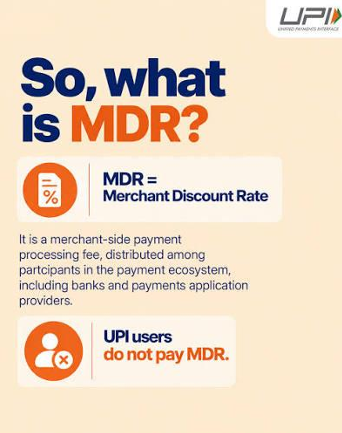
• Targeted MDR Structure: The National Payments Corporation of India (NPCI) notified a Merchant Discount Rate (MDR) of 0.4% on Person-to-Merchant (P2M) UPI transactions exceeding ₹2,000, capped at ₹300 per transaction.
• Complete Consumer Exemption: All Person-to-Person (P2P) transfers and P2M transactions up to ₹2,000 remain completely free of cost, covering 97.5% of total UPI transaction volume.
• Sectoral Concessions: Critical public utility sectors like railways, telecommunications, insurance, and fuel face a flat charge of ₹5 per transaction, while capital market payments attract an MDR of 0.02% (capped at ₹300).
• Exemption for Small Merchants: Small businesses and street vendors receiving up to ₹1 lakh monthly via QR codes under the Person-to-Person-Merchant (P2PM) category remain fully exempt from MDR.
• Revenue Revenue-Sharing Model: Collected MDR is distributed across payment ecosystem participants, where 40% goes to the payer bank, 30% to the payee bank, 20% to ThirdParty Application Providers (TPAPs), and 10% to Payment Service Providers (PSPs).
• Dedicated UPI Promotion Fund: NPCI mandated that 5% of total MDR collections will be allocated toward a dedicated fund aimed at encouraging digital payment adoption among small merchants.
Essential Definitions
• Merchant Discount Rate (MDR): A percentage fee levied on merchants by financial institutions for processing electronic payment transactions through digital payment infrastructure.
• Person-to-Merchant (P2M) Transaction: A digital fund transfer where a retail consumer makes a payment directly to a commercial entity or business for goods or services.
• Third-Party Application Provider (TPAP): An entity that provides a customer-facing application or interface (such as PhonePe or Google Pay) to facilitate UPI payment routing through partner banks.
Legal and Constitutional Framework
• Payment and Settlement Systems Act, 2007: Primary statutory framework governing retail payment networks, containing Section 10A provisions that regulate transaction charges and MDR applicability.
• Section 269SU of Income Tax Act, 1961: Mandates specified business entities to offer prescribed electronic payment facilities to customers.
• Article 246 (Union List, Entry 45 & 46): Grants Parliament sole authority to legislate on Banking, Bills of Exchange, Promissory Notes, and Financial Services regulation.
Conclusion Reintroducing a tiered MDR framework balances digital payment infrastructure sustainability with user financial inclusion. Protecting small-value transactions while monetizing highvalue commercial flows ensures network scalability without obstructing retail digital adoption.
UPSC Relevance
• GS Paper III (Economy & Technology): Digital public infrastructure (DPI), Unified Payments Interface (UPI), financial inclusion, digital economy monetization models, and banking systems.
• GS Paper II (Governance): Policy formulation in digital payments, regulatory oversight by RBI and NPCI, and balancing public interest with private fintech sustainability. 1991 India-Pakistan Treaty Violated Following Naval Vessel Collision Key Highlights & Summary
• Diplomatic Demarche Issued: India summoned Pakistan Charge d’Affaires to lodge a strong protest over the \'unacceptable and unprofessional conduct\' of a Pakistani naval vessel that collided with an Indian warship in international waters.
• Direct Contravention of Article 10: India stated that the unsafe maneuvering by the Pakistani vessel directly violated Article 10 of the bilateral 1991 Agreement on Advance Notice on Military Exercises, Manoeuvres and Troops Movements.
• Mandated Safe Distance: Article 10 of the 1991 pact strictly mandates that naval ships and submarines of both nations must maintain a separation buffer of at least 3 Nautical Miles (approx. 5.55 km) in international waters to prevent maritime accidents.
• Historical Context of the Pact: Signed on April 6, 1991, as a key Confidence-Building Measure (CBM), the treaty aimed to eliminate military miscalculations following major border escalations like Exercise Operation Brass Tacks in 1987.
• Recurrent Maritime Incidents: A similar safety violation occurred on June 16, 2011, when Pakistani warship PNS Babur brushed against Indian frigate INS Godavari during anti-piracy operations in the Gulf of Aden.
• Mutual Advance Notifications: Beyond maritime safety, the agreement requires 15 to 90 days of prior notification for major land, air, and naval exercises near shared borders or Exclusive Economic Zones (EEZ).
Essential Definitions
• Confidence-Building Measures (CBMs): Bilateral military or diplomatic agreements structured to enhance communication, reduce military ambiguity, and prevent unintended armed conflicts.
• Nautical Mile (NM): A standard international unit of measurement used in maritime and air navigation, defined as precisely 1,852 meters (approx. 1.85 km).
• Exclusive Economic Zone (EEZ): A sea zone prescribed by the UNCLOS extending up to 200 nautical miles from a coastal state\'s baseline, over which the state holds sovereign rights for resource exploration and management.
Legal and Constitutional Framework
• Article 10 of the 1991 India-Pakistan Agreement: Codifies specific operational parameters requiring naval units and submarines to maintain a minimum 3 NM clearance in high seas to ensure navigational safety.
• UN Convention on the Law of the Sea (UNCLOS), 1982: Establishes international maritime legal norms governing territorial waters, high seas freedom of navigation, and collision prevention obligations.
• Article 51(c) of Directive Principles (DPSP): Mandates that the State shall endeavour to foster respect for international law and treaty obligations in dealings between organized nations.
Conclusion Adherence to established Confidence-Building Measures like the 1991 agreement is vital for maintaining maritime stability in international waters. Unprofessional naval maneuvers risk escalating local tactical encounters into broader geopolitical confrontations, underscoring the urgent need for strict compliance with military protocols.
UPSC Relevance
• GS Paper II (International Relations): India-Pakistan bilateral relations, Confidence-Building Measures (CBMs), international treaties, and foreign policy demarches.
• GS Paper III (Internal & Maritime Security): Maritime security challenges in the North Arabian Sea, UNCLOS standards, and defense preparedness against territorial/maritime provocations.


Address : 506, 3rd EYE THREE (III), Opp. Induben Khakhrawala, Girish Cold Drink Cross Road, CG Road, Navrangpura, Ahmedabad, 380009.
Mobile : 8469231587 / 9586028957
E-mail: dics.upsc@gmail.com
Address: A-306, The Landmark, Urjanagar-1, Opp. Spicy Street, Kudasan – Por Road, Kudasan, Gandhinagar – 382421
Mobile : 9723832444 / 9723932444
E-mail: dics.gnagar@gmail.com
Address: 2nd Floor, 9 Shivali Society, L&T Circle, opp. Ratri Bazar, Karelibaugh, Vadodara, 390018
Mobile : 9725692037 / 9725692054
E-mail: dics.vadodara@gmail.com
Address: 403, Raj Victoria, Opp. Pal Walkway, Near Galaxy Circle, Pal, Surat-394510
Mobile : 8401031583 / 8401031587
E-mail: dics.surat@gmail.com
Address: 303,305 K 158 Complex Above Magson, Sindhubhavan Road Ahmedabad-380059
Mobile : 9974751177 / 8469231587
E-mail: dicssbr@gmail.com
Address: 57/17, 2nd Floor, Old Rajinder Nagar Market, Bada Bazaar Marg, Delhi-60
Mobile : 9104830862 / 9104830865
E-mail: dics.newdelhi@gmail.com