
Ahmedabad
(Head Office)Address : 506, 3rd EYE THREE (III), Opp. Induben Khakhrawala, Girish Cold Drink Cross Road, CG Road, Navrangpura, Ahmedabad, 380009.
Mobile : 8469231587 / 9586028957
E-mail: dics.upsc@gmail.com


Key Highlights & Summary
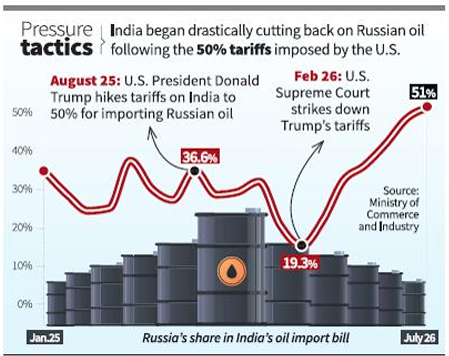
• Rising Weaponised Interdependence: Global financial, maritime, and supply networks are increasingly weaponized, causing unilateral secondary sanctions against nations like Iran and Russia to directly impact Indian enterprises and domestic energy supplies.
• Multilateral Disruption & Tariff Threats: Unilateral U.S. sanctions legislation authorising up to 100% tariffs on buyers of Russian energy, alongside Iranian maritime restrictions in the Strait of Hormuz, present complex dual-front trade risks.
• Limitations of Standalone Measures: Mechanisms like Rupee-denominated trade settlements or legal blocking statutes offer incomplete protection when transaction networks pass through Western clearing banks, maritime insurers, or global shipping lines.
• Proposal for Economic Security War Room: Former diplomat Syed Akbaruddin advocates creating an Economic Security and Sanctions Office under the Cabinet Secretariat to serve as a unified strategic \'war room\' handling economic coercion.
• Inter-Ministerial Coordination: The proposed institutional body would unify decision-making across Foreign Policy, Finance, Commerce, Energy, Shipping, Law, Defence, RBI, and market regulators to track end-to-end supply chain risks.
• Strategic Autonomy Strategy: Unlike China\'s state-directed market leverage, India must adopt a calibrated, legal, and commercial diplomatic framework to protect national interests while maintaining relationships with major global powers.
Essential Definitions
• Weaponised Interdependence: A geopolitical condition where a state leverages its centralized control over key global economic, financial, or physical networks to exert coercive pressure on dependent nations.
• Secondary Sanctions: Penalties imposed by a state on foreign third-party businesses or nations for engaging in economic trade with a primary sanctioned target.
• Economic Security War Room: A centralized, inter-agency administrative mechanism designed to monitor, anticipate, and mitigate external economic coercion and supply chain disruptions.
Legal and Constitutional Framework
• UNSC Mandated vs. Unilateral Sanctions: India legally recognizes sanctions mandated by the United Nations Security Council (UNSC) under Chapter VII of the UN Charter, but rejects non-multilateral, unilateral secondary sanctions.
• Article 73 of the Indian Constitution: Provides the executive power of the Union to manage international treaties, foreign affairs, and trade regulations to safeguard national economic security.
• Foreign Trade (Development and Regulation) Act, 1992: Authorizes the Central Government to formulate export-import policies, regulate international trade flows, and protect domestic commercial interests during geopolitical crises.
Conclusion As economic coercion increasingly targets whole financial and logistical networks, siloed ministerial responses are inadequate. Establishing a dedicated institutional war room under the Cabinet Secretariat will help preserve India\'s economic sovereignty and strategic autonomy amidst volatile global sanctions regimes.
UPSC Relevance
• GS Paper II (International Relations): Impact of foreign policies and sanctions on India\'s interests, strategic autonomy, UN mechanisms versus unilateral sanctions, and global governance frameworks.
• GS Paper III (Economy & Security): Supply chain resilience, energy security, international trade challenges, foreign exchange management, and economic security architectures.


Address : 506, 3rd EYE THREE (III), Opp. Induben Khakhrawala, Girish Cold Drink Cross Road, CG Road, Navrangpura, Ahmedabad, 380009.
Mobile : 8469231587 / 9586028957
E-mail: dics.upsc@gmail.com
Address: A-306, The Landmark, Urjanagar-1, Opp. Spicy Street, Kudasan – Por Road, Kudasan, Gandhinagar – 382421
Mobile : 9723832444 / 9723932444
E-mail: dics.gnagar@gmail.com
Address: 2nd Floor, 9 Shivali Society, L&T Circle, opp. Ratri Bazar, Karelibaugh, Vadodara, 390018
Mobile : 9725692037 / 9725692054
E-mail: dics.vadodara@gmail.com
Address: 403, Raj Victoria, Opp. Pal Walkway, Near Galaxy Circle, Pal, Surat-394510
Mobile : 8401031583 / 8401031587
E-mail: dics.surat@gmail.com
Address: 303,305 K 158 Complex Above Magson, Sindhubhavan Road Ahmedabad-380059
Mobile : 9974751177 / 8469231587
E-mail: dicssbr@gmail.com
Address: 57/17, 2nd Floor, Old Rajinder Nagar Market, Bada Bazaar Marg, Delhi-60
Mobile : 9104830862 / 9104830865
E-mail: dics.newdelhi@gmail.com