
Ahmedabad
(Head Office)Address : 506, 3rd EYE THREE (III), Opp. Induben Khakhrawala, Girish Cold Drink Cross Road, CG Road, Navrangpura, Ahmedabad, 380009.
Mobile : 8469231587 / 9586028957
E-mail: dics.upsc@gmail.com

Key Highlights & Summary
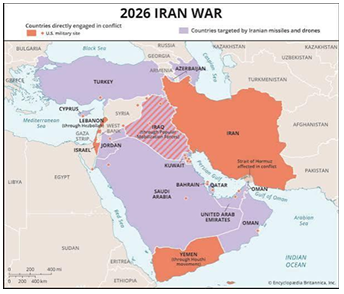
• Negotiations between Iran and the United States have resumed after the June 17 Islamabad Memorandum unravelled within weeks, leading both sides to resume their blockades of the Strait of Hormuz and Iranian ports. The war is now seven months old.
• Both sides realise that time is not on their side. Domestic pressures, including the November 3 US mid-term elections and anti-establishment unrest in Iran, make a prolonged conflict costly. President Trump dismissed Iran\'s seven-point proposal on September 26, which may be an opening gambit for better terms.
• The US has a clear quantitative edge (three times the population, 85 times the GDP, 20 times the military budget), yet Iran has not capitulated. Its asymmetric strategy and a historical memory of being an underdog have hardened its resolve, while the US faces inflation, ammunition depletion and isolation.
• The path ahead is uncertain. The exact contents of the Iranian proposal are unclear, and mistrust has deepened after tit-for-tat attacks and the US \'Operation Economic Outcast\'. Positive signs include Qatari mediation, Iranian flexibility on Hormuz and an interim supervisory arrangement with Oman.
• Any deal is likely to be a temporary \'Hudna\' (truce) lasting till the elections. Contentious issues such as nuclear and missile programmes and proxy groups could bring a \'high noon\' by mid-November. Iran may also use a possible al-Houthi blockade of Bab al-Mandeb as an escalatory lever.
• The Israel-Iran rivalry will outlast any US-Iran deal. Gulf states, Iraq and Jordan suffered collateral damage, and their long-standing security reliance on the US needs reappraisal. Oil is now tied more to geopolitics than to supply-demand balance.
Essential Definitions
• Strait of Hormuz: A narrow waterway between Iran and Oman connecting the Persian Gulf to the Arabian Sea, through which roughly one-fifth of global oil trade passes.
• Bab al-Mandeb: A strait between Yemen and Djibouti linking the Red Sea to the Gulf of Aden, critical for Suez Canal traffic.
• Hudna: An Arabic term for a temporary truce or ceasefire.
• Modus vivendi: A practical arrangement allowing conflicting parties to coexist while disputes remain unresolved.
• Asymmetric warfare: Strategy in which a weaker party uses unconventional means, such as proxies, drones and missiles, to offset a stronger adversary.
Legal and Constitutional Framework
• UN Charter, Article 2(4) and Article 51: Prohibition on use of force and the right of self-defence, central to legality debates on the war.
• UNCLOS, 1982: Provides the right of transit passage through international straits like Hormuz.
• JCPOA (2015): The Iran nuclear deal, from which the US withdrew in 2018.
• Article 51 of the Indian Constitution (Directive Principle): Promotion of international peace and security, and peaceful settlement of disputes.
• Article 253: Parliament\'s power to legislate for implementing international treaties.
• India\'s energy security: Dependence on West Asia for crude oil and diaspora remittances shapes India\'s strategic autonomy and balanced diplomacy.
• Related initiatives: India-Middle East-Europe Economic Corridor (IMEC) and Chabahar Port.
Conclusion Both Tehran and Washington face mounting costs and shrinking room for manoeuvre. A short-term truce is possible, but lasting peace needs trust-building, clarity on nuclear and proxy issues, and regional buy-in. For India, a stable Gulf is vital for energy, trade and the diaspora.
UPSC Relevance
• Prelims: Strait of Hormuz, Bab al-Mandeb, JCPOA, Chabahar Port, IMEC, Qatar and Oman on the map.
• Mains GS-II: India and West Asia, effect of policies of developed countries on India, bilateral and regional groupings, diaspora.
• Mains GS-III: Energy security, oil price volatility and its impact on the economy.
• Mains GS-I: Post-war geopolitical realignments and the balance of power.
• Essay and Interview: Themes like \'Wars of choice and their costs\' and \'Energy security in a fragmented world\'.


Address : 506, 3rd EYE THREE (III), Opp. Induben Khakhrawala, Girish Cold Drink Cross Road, CG Road, Navrangpura, Ahmedabad, 380009.
Mobile : 8469231587 / 9586028957
E-mail: dics.upsc@gmail.com
Address: A-306, The Landmark, Urjanagar-1, Opp. Spicy Street, Kudasan – Por Road, Kudasan, Gandhinagar – 382421
Mobile : 9723832444 / 9723932444
E-mail: dics.gnagar@gmail.com
Address: 2nd Floor, 9 Shivali Society, L&T Circle, opp. Ratri Bazar, Karelibaugh, Vadodara, 390018
Mobile : 9725692037 / 9725692054
E-mail: dics.vadodara@gmail.com
Address: 403, Raj Victoria, Opp. Pal Walkway, Near Galaxy Circle, Pal, Surat-394510
Mobile : 8401031583 / 8401031587
E-mail: dics.surat@gmail.com
Address: 303,305 K 158 Complex Above Magson, Sindhubhavan Road Ahmedabad-380059
Mobile : 9974751177 / 8469231587
E-mail: dicssbr@gmail.com
Address: 57/17, 2nd Floor, Old Rajinder Nagar Market, Bada Bazaar Marg, Delhi-60
Mobile : 9104830862 / 9104830865
E-mail: dics.newdelhi@gmail.com