
Ahmedabad
(Head Office)Address : 506, 3rd EYE THREE (III), Opp. Induben Khakhrawala, Girish Cold Drink Cross Road, CG Road, Navrangpura, Ahmedabad, 380009.
Mobile : 8469231587 / 9586028957
E-mail: dics.upsc@gmail.com

Key Highlights & Summary
• The elevation of seven district judges to the Delhi High Court has drawn attention to the narrow path from the subordinate judiciary to the higher Bench. Judicial officers account for only a fraction of High Court judges despite spending decades deciding cases at the trial-court level.
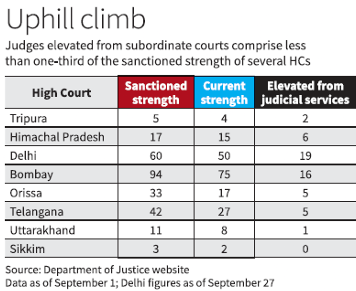
• Delhi High Court working strength has risen to 50 against a sanctioned strength of 60, of which 19 judges have been drawn from the subordinate courts.
• Article 217 provides two streams for High Court appointments, members of the Bar and judicial officers, but prescribes no fixed ratio. A conventional norm holds that two-thirds of vacancies go to the Bar and one-third to the judicial service cadre.
• The one-third norm is not met in most States. Of the 1,114 sanctioned High Court judges, only 233 (about 21%) are elevated from the district judiciary. Tripura (40%), Himachal Pradesh (35.29%) and Delhi (31.67%) meet or exceed the norm, while service judges form just 9.09% in Uttarakhand, 11.90% in Chhattisgarh and Sikkim has zero representation.
• Career bottlenecks are severe. Most law graduates join judicial service in their late twenties, take about 10 years to become a senior civil judge and another decade to become a district judge. They are often in their late fifties at the time of consideration, leaving a few years before retirement at 62. The Supreme Court currently has no sitting judge who began in the trial court judiciary, the last being Justice Bela M. Trivedi (appointed August 2021, retired June 2025).
• In 2023 the Judicial Service Association of Delhi sought a direction to fill 50% of High Court seats from the service quota. A Bench led by Justice B.R. Gavai declined, leaving the association free to pursue other remedies. Justice R.K. Gauba suggested that recommendations from the service cadre be processed in advance, so that vacancies are not left open for years.
Essential Definitions
• Subordinate judiciary: Courts below the High Court, including district courts and lower courts, staffed through judicial service.
• Judicial service quota: The customary share of High Court vacancies reserved for judicial officers, generally one-third.
• Collegium system: The mechanism by which the Chief Justice of India and senior judges recommend appointments and transfers of judges to the higher judiciary.
• Career progression bottleneck: Stagnation in promotion due to limited posts and late age of elevation.
Legal and Constitutional Framework
• Article 217: Appointment and conditions of the office of a High Court judge. The eligibility requirement is ten years as a judicial officer or ten years as an advocate of a High Court.
• Article 124: Appointment of Supreme Court judges, in consultation with judges of the Supreme Court and High Courts.
• Article 233 and Article 235: Appointment of district judges by the Governor and High Court control over subordinate courts.
• Article 50: Separation of the judiciary from the executive, a Directive Principle.
• Second Judges Case (1993) and Third Judges Case (1998): Established the collegium system and the primacy of the judiciary in appointments.
• National Judicial Appointments Commission (NJAC) Act, 2014: Struck down in 2015 by the Supreme Court as violating the basic structure.
• All India Judges Association v. Union of India: Directions on service conditions and career progression of judicial officers.
• Memorandum of Procedure: Guides the process of appointing High Court judges.
Conclusion A diverse Bench that draws on both the Bar and the service cadre strengthens the quality and legitimacy of the judiciary. Timely recommendations, transparent criteria and adherence to the onethird norm can motivate talented law graduates to join the lower judiciary and improve access to justice.
UPSC Relevance
• Prelims: Article 217, Article 124, collegium system, NJAC, Article 50, judicial service.
• Mains GS-II: Judiciary structure, appointments, transparency and accountability, judicial reforms.
• Mains GS-II: Pendency of cases and vacancies in High Courts.
• Mains GS-IV: Merit, integrity and institutional fairness.
• Essay and Interview: Themes like \'Judicial diversity\' and \'Reforming judicial appointments in India\'.


Address : 506, 3rd EYE THREE (III), Opp. Induben Khakhrawala, Girish Cold Drink Cross Road, CG Road, Navrangpura, Ahmedabad, 380009.
Mobile : 8469231587 / 9586028957
E-mail: dics.upsc@gmail.com
Address: A-306, The Landmark, Urjanagar-1, Opp. Spicy Street, Kudasan – Por Road, Kudasan, Gandhinagar – 382421
Mobile : 9723832444 / 9723932444
E-mail: dics.gnagar@gmail.com
Address: Tithi Commercial Complex, 401/402 Productivity Road, Opp. Productivity House, Alkapuri, Vadodara, Gujarat – 390007
Mobile : 9725692037 / 9725692054
E-mail: dics.vadodara@gmail.com
Address: 403, Raj Victoria, Opp. Pal Walkway, Near Galaxy Circle, Pal, Surat-394510
Mobile : 8401031583 / 8401031587
E-mail: dics.surat@gmail.com
Address: 303,305 K 158 Complex Above Magson, Sindhubhavan Road Ahmedabad-380059
Mobile : 9974751177 / 8469231587
E-mail: dicssbr@gmail.com
Address: 57/17, 2nd Floor, Old Rajinder Nagar Market, Bada Bazaar Marg, Delhi-60
Mobile : 9104830862 / 9104830865
E-mail: dics.newdelhi@gmail.com