


Ahmedabad
(Head Office)Address : 506, 3rd EYE THREE (III), Opp. Induben Khakhrawala, Girish Cold Drink Cross Road, CG Road, Navrangpura, Ahmedabad, 380009.
Mobile : 8469231587 / 9586028957
E-mail: dics.upsc@gmail.com

Key Highlights & Summary
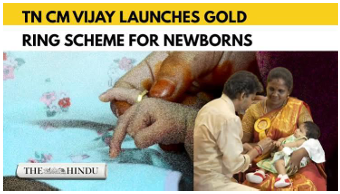
• Tamil Nadu Chief Minister C. Joseph Vijay launched the Thaimaman Thanga Mothiram Thittam (Maternal Uncle\'s Gold Ring Scheme) at Government Rajaji Hospital, Madurai, fulfilling one of the TVK government\'s prominent election promises.
• Every eligible baby born in a government health institution receives a one-gram, 22-carat gold ring. The scheme applies retrospectively to babies born in government hospitals and primary health centres from June 22, and both boys and girls are eligible.
• The state has earmarked Rs 755.83 crore annually, estimated to cover about 4.42 lakh deliveries in government health facilities each year.
• The mother must be a Tamil Nadu resident, registered under the Pregnancy and Infant Cohort Monitoring and Evaluation (PICME) system, and hold a Reproductive and Child Health (RCH) ID.
• The government has procured 1.28 lakh rings in the first phase. Each BIS-hallmarked ring carries a unique serial number and is supplied in tamper-proof packaging. At the launch, rings were presented to 27 infants.
• The scheme borrows its name from the Tamil tradition of a maternal uncle gifting to his sister\'s child. It aims to encourage institutional deliveries, though the rollout has been temporarily withheld in Maduranthakam and Dharapuram Assembly constituencies.
Essential Definitions
• Institutional delivery: Childbirth taking place in a recognised health facility under the supervision of trained health personnel, which reduces maternal and infant mortality.
• PICME: A Tamil Nadu health information system that tracks pregnant women and infants from registration to the child\'s first year.
• Hallmarking: Certification by the Bureau of Indian Standards (BIS) that guarantees the purity of gold jewellery.
• Conditional cash or in-kind transfer: Benefit given to a beneficiary on fulfilling a specified condition, here a birth in a public facility.
• Freebie or welfare debate: The question of whether populist benefits amount to legitimate welfare or fiscally unsound electoral inducements.
Legal and Constitutional Framework
• Article 47: Directive Principle making improvement of public health and nutrition a primary duty of the State.
• Article 21: Right to life, which includes the right to health and reproductive healthcare (Paschim Banga Khet Mazdoor Samity, 1996).
• Article 15(3) and Article 39(f): Special provisions for women and children, and healthy development of children.
• Seventh Schedule: Public health is a State List subject (Entry 6), giving states the freedom to design such schemes.
• National Health Mission and Janani Suraksha Yojana: Central schemes promoting institutional deliveries with cash incentives.
• S. Subramaniam Balaji v. State of Tamil Nadu (2013): The Supreme Court held that promises in manifestos are not corrupt practices under the Representation of the People Act, 1951, while recommending guidelines.
• Article 293 and FRBM framework: Limits on state borrowing and fiscal discipline.
• Model Code of Conduct: Explains the withholding of the rollout in the two constituencies.
Conclusion The scheme reflects a culturally rooted approach to encouraging institutional births, and Tamil Nadu already performs well on maternal health indicators. Its long-term value will depend on service quality in public hospitals, fiscal prudence and outcomes such as lower infant mortality, rather than symbolic gifts alone.
UPSC Relevance
• Prelims: Article 47, Janani Suraksha Yojana, National Health Mission, BIS hallmarking, PICME, Model Code of Conduct.
• Mains GS-II: Welfare schemes for vulnerable sections, health, issues relating to development and management of social sector services.
• Mains GS-II: Federalism and state-level welfare innovations.
• Mains GS-III: Fiscal prudence and the freebie debate.
• Essay and Interview: Themes like \'Welfare versus populism\' and \'Incentives and institutional deliveries\'.


Address : 506, 3rd EYE THREE (III), Opp. Induben Khakhrawala, Girish Cold Drink Cross Road, CG Road, Navrangpura, Ahmedabad, 380009.
Mobile : 8469231587 / 9586028957
E-mail: dics.upsc@gmail.com
Address: A-306, The Landmark, Urjanagar-1, Opp. Spicy Street, Kudasan – Por Road, Kudasan, Gandhinagar – 382421
Mobile : 9723832444 / 9723932444
E-mail: dics.gnagar@gmail.com
Address: Tithi Commercial Complex, 401/402 Productivity Road, Opp. Productivity House, Alkapuri, Vadodara, Gujarat – 390007
Mobile : 9725692037 / 9725692054
E-mail: dics.vadodara@gmail.com
Address: 403, Raj Victoria, Opp. Pal Walkway, Near Galaxy Circle, Pal, Surat-394510
Mobile : 8401031583 / 8401031587
E-mail: dics.surat@gmail.com
Address: 303,305 K 158 Complex Above Magson, Sindhubhavan Road Ahmedabad-380059
Mobile : 9974751177 / 8469231587
E-mail: dicssbr@gmail.com
Address: 57/17, 2nd Floor, Old Rajinder Nagar Market, Bada Bazaar Marg, Delhi-60
Mobile : 9104830862 / 9104830865
E-mail: dics.newdelhi@gmail.com