

Ahmedabad
(Head Office)Address : 506, 3rd EYE THREE (III), Opp. Induben Khakhrawala, Girish Cold Drink Cross Road, CG Road, Navrangpura, Ahmedabad, 380009.
Mobile : 8469231587 / 9586028957
E-mail: dics.upsc@gmail.com

Key Highlights & Summary
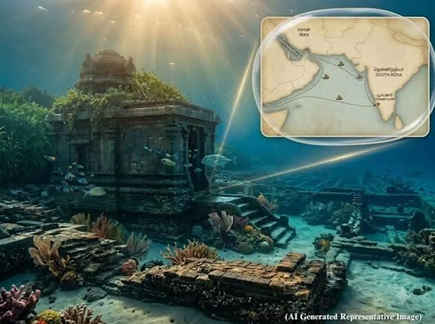
• Fresh excavation: An 18-day underwater exploration off Poompuhar (Kaveripoompattinam), Mayiladuthurai district, Tamil Nadu, was conducted by the Tamil Nadu State Department of Archaeology (TNSDA) with the Indian Maritime University. It recovered a fragment of a West Asian \'torpedo jar\', four terracotta ring wells and over 250 ceramic fragments.
• Ancient port: Poompuhar lay at the mouth of the Kaveri, where it meets the Bay of Bengal, and is believed to have been the capital of the early Cholas. Carbon dating of a wood log suggests the city existed from the 5th-4th century BCE. It had three divisions: Maruvurpakkam (seashore), Pattinappakkam (west) and Nalangadi (between the two).
• Trade links: Merchandise exported from the port was stamped with a tiger symbol, the Chola emblem. Goods from the Ganges region, and food products from Ceylon and Java, were imported. The torpedo jar, used to carry wine and olive oil, points to links with West Asia and the Mediterranean.
• Sangam-era remains: Earlier finds include brick structures, terracotta ring wells, storage jars and clay patches, probably the remains of a public building, wharf and reservoir. A 1996 study noted that ships for Southeast Asia, Arabia and Rome sailed from here.
• Submerged habitation: Megalithic pottery found offshore suggests habitation extended beyond the present shoreline. Ring wells on the seabed may indicate a buried palaeochannel, later submerged by coastal erosion and rising sea levels.
• Lost city debate: Floods in the 4th-5th century CE swallowed major parts of the city. The Manimekalai tradition attributes the loss to the sea goddess\'s wrath, and some studies suggest a tsunami around the 3rd century CE. Scholars consider partial submergence more probable than total loss.
Essential Definitions
• Underwater archaeology: The study of human past through sites, ships and artefacts lying beneath seas, rivers or lakes.
• Torpedo jar: A narrow, elongated ceramic vessel used in ancient trade to carry liquids such as wine and oil.
• Ring wells: Wells lined with stacked terracotta rings, usually built on dry land for freshwater.
• Palaeochannel: An abandoned river channel, later buried or filled by sediments.
• Sangam period: The early historic phase of South India, roughly 3rd century BCE to 3rd century CE, known for Tamil literature and maritime trade.
Legal and Constitutional Framework
• Article 49 (DPSP): The State shall protect monuments and places of artistic or historic interest declared to be of national importance.
• Article 51A(f): Fundamental duty to value and preserve the rich heritage of our composite culture.
• Entry 67, Union List: Ancient and historical monuments and archaeological sites declared by Parliament to be of national importance.
• Entry 12, State List: Libraries, museums and other institutions, and ancient monuments not declared national.
• Entry 40, Union List: Archaeological sites of national importance.
• Ancient Monuments and Archaeological Sites and Remains Act, 1958: Regulates protection, excavation and conservation, and covers underwater sites within territorial waters.
• Antiquities and Art Treasures Act, 1972: Regulates trade and export of antiquities.
• UNESCO Convention on the Protection of the Underwater Cultural Heritage, 2001: Provides for preservation of underwater heritage; India is not a party.
Conclusion The excavations strengthen evidence of India\'s ancient maritime networks and the Tamil contribution to Indian Ocean trade. Regular scientific surveys, stronger legal protection for underwater sites, and coastal management are needed. Combining archaeology with climate and sea-level studies will also enrich understanding of past human adaptation.
UPSC Relevance
• Prelims: Sangam age, Cholas, Poompuhar, Keezhadi, Arikamedu, ASI, ancient ports of India.
• Mains GS-I: Indian heritage, art and culture, ancient maritime trade and Indian Ocean linkages.
• Mains GS-III: Coastal erosion, sea-level rise and disaster management. • Essay: Heritage preservation and lessons from the past.


Address : 506, 3rd EYE THREE (III), Opp. Induben Khakhrawala, Girish Cold Drink Cross Road, CG Road, Navrangpura, Ahmedabad, 380009.
Mobile : 8469231587 / 9586028957
E-mail: dics.upsc@gmail.com
Address: A-306, The Landmark, Urjanagar-1, Opp. Spicy Street, Kudasan – Por Road, Kudasan, Gandhinagar – 382421
Mobile : 9723832444 / 9723932444
E-mail: dics.gnagar@gmail.com
Address: 2nd Floor, 9 Shivali Society, L&T Circle, opp. Ratri Bazar, Karelibaugh, Vadodara, 390018
Mobile : 9725692037 / 9725692054
E-mail: dics.vadodara@gmail.com
Address: 403, Raj Victoria, Opp. Pal Walkway, Near Galaxy Circle, Pal, Surat-394510
Mobile : 8401031583 / 8401031587
E-mail: dics.surat@gmail.com
Address: 303,305 K 158 Complex Above Magson, Sindhubhavan Road Ahmedabad-380059
Mobile : 9974751177 / 8469231587
E-mail: dicssbr@gmail.com
Address: 57/17, 2nd Floor, Old Rajinder Nagar Market, Bada Bazaar Marg, Delhi-60
Mobile : 9104830862 / 9104830865
E-mail: dics.newdelhi@gmail.com