

Ahmedabad
(Head Office)Address : 506, 3rd EYE THREE (III), Opp. Induben Khakhrawala, Girish Cold Drink Cross Road, CG Road, Navrangpura, Ahmedabad, 380009.
Mobile : 8469231587 / 9586028957
E-mail: dics.upsc@gmail.com

Key Highlights & Summary
• Background: The Wildlife Crime Control Bureau (WCCB) is examining an alleged crossborder trafficking of a live female elephant from Nepal. The trail leads to Wildlife SOS, an NGO running bear and elephant rescue centres in Agra and Mathura. The case follows a separate leopard poaching probe.
• Origin of the lead: In March 2022, the WCCB arrested a UP Police sub-inspector, his son and an accomplice in Jaipur with about 30 kg of ivory and a licensed revolver. Chats on one accused\'s phone referred to \'Suraj Pal\'s elephant\'. Pal has worked as an elephant keeper at Wildlife SOS since 2011.
• Smuggling route: According to interrogation records, a 35-40-year-old elephant was smuggled through the Hathiheva (Nepal) border to Kakrava in Kushinagar (UP) during the 2020 Covid lockdown. It was sold through intermediaries for Rs 40 lakh and then Rs 70 lakh.
• NGO response: Wildlife SOS says Pal was employed only briefly until 2016 and it cannot comment on his later activities. Its CEO and director of conservation deny any knowledge of the chats.
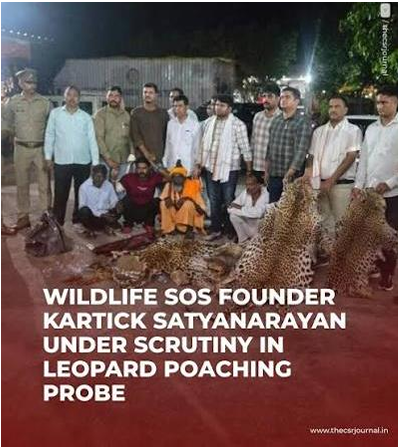
• Ongoing action: Two Wildlife SOS employees were arrested by MP Special Task Force (STF) for alleged involvement in poaching 10 leopards in the Shivpuri-Morena landscape. The CEO has interim protection from the Supreme Court and must appear before investigators on September 28.
• Concerns raised: Wildlife crime investigators have long questioned the NGO\'s rescue and anti-poaching methods, including allegations that bear cubs were collected from the wild. Cross-agency coordination gaps and a lack of \'smoking gun\' evidence hindered earlier action.
Essential Definitions
• Wildlife trafficking: Illegal capture, trade, transport or possession of wild animals and their derivatives, often across borders.
• WCCB: A statutory body under the MoEFCC, set up under the Wild Life (Protection) Act, 1972, to combat organised wildlife crime. • Ivory trade: Commerce in elephant tusks, prohibited in India under the Wild Life (Protection) Act, 1972 and internationally under CITES.
• Interim protection: Temporary judicial relief from arrest while an investigation or legal proceeding is pending.
Legal and Constitutional Framework
• Wild Life (Protection) Act, 1972: Elephants are protected under Schedule I. The Act bars hunting, trade in animals and animal articles, and possession of ivory, with stringent penalties. The 2022 Amendment strengthened CITES compliance and regulates captive elephants.
• Article 48A (DPSP): The State shall protect and improve the environment and safeguard forests and wildlife. • Article 51A(g): Fundamental duty of every citizen to protect the natural environment and have compassion for living creatures. • Article 21: The Supreme Court has read the right to a healthy environment into the right to life.
• CITES: India is a party. Asian elephants are listed in Appendix I, which bans commercial international trade.
• Transboundary cooperation: The Customs Act, 1962 and the Prevention of Money Laundering Act, 2002 support action against cross-border smuggling networks.
• Judicial safeguards: Article 32 enables the Supreme Court to grant interim protection, subject to cooperation with the investigation. Conclusion The case exposes gaps in monitoring captive elephants, verifying rescue centres and coordinating between central and state agencies. Strong regulation, DNA and microchip-based tracking of captive elephants, and closer India-Nepal border cooperation are essential. Accountability must extend to NGOs performing quasi-public conservation functions, while due process is respected.
UPSC Relevance
• Prelims: WCCB, CITES appendices, Schedule I species, Project Elephant, Elephant Reserves, IUCN status of the Asian elephant.
• Mains GS-III: Environment, conservation, and internal security challenges at borders.
• Mains GS-II: Role of NGOs and accountability, and the working of statutory bodies.
• Essay/Ethics: Conservation ethics, animal welfare versus commercial exploitation, and transparency in civil society organisations.


Address : 506, 3rd EYE THREE (III), Opp. Induben Khakhrawala, Girish Cold Drink Cross Road, CG Road, Navrangpura, Ahmedabad, 380009.
Mobile : 8469231587 / 9586028957
E-mail: dics.upsc@gmail.com
Address: A-306, The Landmark, Urjanagar-1, Opp. Spicy Street, Kudasan – Por Road, Kudasan, Gandhinagar – 382421
Mobile : 9723832444 / 9723932444
E-mail: dics.gnagar@gmail.com
Address: 2nd Floor, 9 Shivali Society, L&T Circle, opp. Ratri Bazar, Karelibaugh, Vadodara, 390018
Mobile : 9725692037 / 9725692054
E-mail: dics.vadodara@gmail.com
Address: 403, Raj Victoria, Opp. Pal Walkway, Near Galaxy Circle, Pal, Surat-394510
Mobile : 8401031583 / 8401031587
E-mail: dics.surat@gmail.com
Address: 303,305 K 158 Complex Above Magson, Sindhubhavan Road Ahmedabad-380059
Mobile : 9974751177 / 8469231587
E-mail: dicssbr@gmail.com
Address: 57/17, 2nd Floor, Old Rajinder Nagar Market, Bada Bazaar Marg, Delhi-60
Mobile : 9104830862 / 9104830865
E-mail: dics.newdelhi@gmail.com