Ahmedabad
(Head Office)Address : 506, 3rd EYE THREE (III), Opp. Induben Khakhrawala, Girish Cold Drink Cross Road, CG Road, Navrangpura, Ahmedabad, 380009.
Mobile : 8469231587 / 9586028957
E-mail: dics.upsc@gmail.com

Key Highlights & Summary
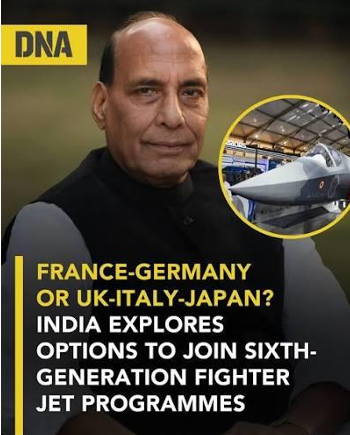
• Sixth-generation push: Defence Minister Rajnath Singh said at the News Channel Defence Summit that India is working towards developing sixth-generation fighter jets. He acknowledged challenges on this path but said the resolve remains unwavering.
• Message to Pakistan: He said that as long as the neighbouring country persists with a state policy of terrorism, India remains fully free to carry out all forms of strikes against it.
• Nature of warfare: He noted that the world is in an era of fifth-generation warfare, which blends cyber, information, economic and psychological tools with conventional force.
• Supply chains as conflict zones: Supply chains are becoming a new ground of geopolitical conflict. This strengthens the case for self-reliance in defence manufacturing and critical technologies.
• India global position: Singh described India as neither a status quo power nor a revisionist power, but a civilisational power. This reflects a stance of strategic autonomy and rules-based order without seeking to overturn the existing system.
• Link to indigenisation: The programme fits with Aatmanirbhar Bharat in defence, including the Advanced Medium Combat Aircraft (AMCA), the fifth-generation stealth fighter project, and the Tejas programme.
Essential Definitions
• Sixth-generation fighter: An advanced aircraft concept featuring AI-assisted decision-making, advanced stealth, manned-unmanned teaming, directed-energy weapons and network-centric operations.
• Fifth-generation warfare: Conflict conducted through nonkinetic means such as cyber attacks, disinformation and economic pressure, alongside conventional operations.
• Status quo power: A state that seeks to preserve the existing international order.
• Revisionist power: A state that seeks to alter the existing international order or its rules.
• State-sponsored terrorism: Support by a state, through funds, training or shelter, to groups that carry out terrorist violence.
Legal and Constitutional Framework
• Article 51 (DPSP): The State shall promote international peace and security, and just and honourable relations between nations.
• Article 52 and Article 53: The President is the head of the Union, and the supreme command of the Defence Forces is vested in the President, exercised as per law.
• Article 246 and Entries 1 and 2, Union List: Defence of India and the armed forces fall under exclusive Union jurisdiction.
• Article 355: The Union has a duty to protect states against external aggression and internal disturbance.
• Article 51A(d): Fundamental duty to defend the country and render national service when called upon. • Article 33: Parliament can restrict fundamental rights of armed forces personnel to ensure discipline.
• Article 51 and Article 2(4) and Article 51 of the UN Charter: India\'s actions must be seen against the international law on use of force and the right of self-defence.
• Unlawful Activities (Prevention) Act, 1967: The primary domestic law against terrorism and unlawful associations.
• Defence Acquisition Procedure, 2020: Provides for indigenous design, development and manufacture, with the Buy (Indian-IDDM) category as top priority.
Conclusion India\'s emphasis on next-generation air power reflects the shift towards technology-driven, multidomain warfare. Sustained investment in R&D, private-sector participation, secure supply chains and skilled manpower is essential. A firm counter-terror doctrine, together with strategic autonomy and self-reliance, will strengthen national security and India\'s standing as a responsible civilisational power.
UPSC Relevance
• Prelims: AMCA, Tejas, generations of fighter aircraft, DAP 2020, iDEX, Defence Corridors, Article 355.
• Mains GS-III: Indigenisation of defence technology, internal and external security challenges, cyber warfare and terrorism.
• Mains GS-II: India\'s neighbourhood policy, strategic autonomy and India\'s role in the global order.
• Essay/Ethics: Technology and national security, and peace versus deterrence.


Address : 506, 3rd EYE THREE (III), Opp. Induben Khakhrawala, Girish Cold Drink Cross Road, CG Road, Navrangpura, Ahmedabad, 380009.
Mobile : 8469231587 / 9586028957
E-mail: dics.upsc@gmail.com
Address: A-306, The Landmark, Urjanagar-1, Opp. Spicy Street, Kudasan – Por Road, Kudasan, Gandhinagar – 382421
Mobile : 9723832444 / 9723932444
E-mail: dics.gnagar@gmail.com
Address: 2nd Floor, 9 Shivali Society, L&T Circle, opp. Ratri Bazar, Karelibaugh, Vadodara, 390018
Mobile : 9725692037 / 9725692054
E-mail: dics.vadodara@gmail.com
Address: 403, Raj Victoria, Opp. Pal Walkway, Near Galaxy Circle, Pal, Surat-394510
Mobile : 8401031583 / 8401031587
E-mail: dics.surat@gmail.com
Address: 303,305 K 158 Complex Above Magson, Sindhubhavan Road Ahmedabad-380059
Mobile : 9974751177 / 8469231587
E-mail: dicssbr@gmail.com
Address: 57/17, 2nd Floor, Old Rajinder Nagar Market, Bada Bazaar Marg, Delhi-60
Mobile : 9104830862 / 9104830865
E-mail: dics.newdelhi@gmail.com