



Ahmedabad
(Head Office)Address : 506, 3rd EYE THREE (III), Opp. Induben Khakhrawala, Girish Cold Drink Cross Road, CG Road, Navrangpura, Ahmedabad, 380009.
Mobile : 8469231587 / 9586028957
E-mail: dics.upsc@gmail.com

Key Highlights & Summary
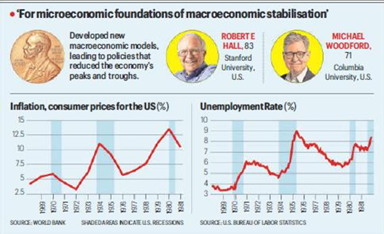
• The Sveriges Riksbank Prize in Economic Sciences in Memory of Alfred Nobel 2026 was awarded to Robert E. Hall and Michael Woodford for providing the microeconomic foundations of macroeconomic stabilisation.
• Robert Hall analyzed the demand side, using microdata to demonstrate how household consumption choices vary based on income expectations and financial constraints, disproving simple linear consumption models.
• Michael Woodford focused on the supply side, showing how firm pricing behavior depends on expectations of future interest rates and central bank forward guidance.
• Their research revitalized Keynesian stabilization policy by grounding broad national policies in empirical, real-world decision-making mechanisms of individuals and firms.
• Macroeconomic stabilization policies combine monetary tools (e.g., central bank interest rate adjustments) and fiscal tools (e.g., government tax adjustments) to smooth out economic cycles of inflation and recession.
• The framework explains why transparent communication and policy predictability by central banks are essential to anchors market expectations and maintain economic stability during global crises.
Essential Definitions
• Macroeconomic Stabilisation: Government and central bank policy interventions, using monetary and fiscal instruments, aimed at reducing economic volatility, controlling inflation, and preventing deep recessions.
• Microeconomic Foundations: The practice of explaining aggregate economic phenomena (such as national inflation or unemployment) through the underlying decisions, behaviors, and expectations of individual consumers and firms.
• Forward Guidance: Strategic public communication by a central bank regarding its future monetary policy stance to influence market expectations and long-term borrowing costs.
• Stagflation: An economic scenario characterized simultaneously by stagnant economic growth, high unemployment, and rising inflation.
Legal and Constitutional Framework
• Reserve Bank of India Act, 1934: Grants statutory power to the RBI to implement monetary policy, manage liquidity, and adjust policy interest rates to maintain price stability while supporting growth.
• Fiscal Responsibility and Budget Management (FRBM) Act, 2003: Sets legal mandates for fiscal deficit targets, guiding counter-cyclical government spending and tax policies during economic slowdowns.
• Articles 112 and 114 of the Constitution: Establish the constitutional mechanism for the Union Budget, laying down statutory procedures for fiscal expenditure and tax adjustments aimed at economic stabilization.
Conclusion The Nobel-winning work of Hall and Woodford demonstrates that effective economic policy requires a precise understanding of micro-level behavior. Incorporating behavioral expectations into monetary and fiscal design enables policymakers to stabilize markets, mitigate supply-side shocks, and ensure sustained macroeconomic resilience.
UPSC Relevance
• GS Paper III (Indian Economy): Directly relevant to core syllabus topics including Monetary Policy, Fiscal Policy, Inflation Management, Business Cycles, Macroeconomic Indicators, and Central Bank Policy Frameworks.


Address : 506, 3rd EYE THREE (III), Opp. Induben Khakhrawala, Girish Cold Drink Cross Road, CG Road, Navrangpura, Ahmedabad, 380009.
Mobile : 8469231587 / 9586028957
E-mail: dics.upsc@gmail.com
Address: A-306, The Landmark, Urjanagar-1, Opp. Spicy Street, Kudasan – Por Road, Kudasan, Gandhinagar – 382421
Mobile : 9723832444 / 9723932444
E-mail: dics.gnagar@gmail.com
Address: Tithi Commercial Complex, 401/402 Productivity Road, Opp. Productivity House, Alkapuri, Vadodara, Gujarat – 390007
Mobile : 9725692037 / 9725692054
E-mail: dics.vadodara@gmail.com
Address: 403, Raj Victoria, Opp. Pal Walkway, Near Galaxy Circle, Pal, Surat-394510
Mobile : 8401031583 / 8401031587
E-mail: dics.surat@gmail.com
Address: 303,305 K 158 Complex Above Magson, Sindhubhavan Road Ahmedabad-380059
Mobile : 9974751177 / 8469231587
E-mail: dicssbr@gmail.com
Address: 57/17, 2nd Floor, Old Rajinder Nagar Market, Bada Bazaar Marg, Delhi-60
Mobile : 9104830862 / 9104830865
E-mail: dics.newdelhi@gmail.com