

Ahmedabad
(Head Office)Address : 506, 3rd EYE THREE (III), Opp. Induben Khakhrawala, Girish Cold Drink Cross Road, CG Road, Navrangpura, Ahmedabad, 380009.
Mobile : 8469231587 / 9586028957
E-mail: dics.upsc@gmail.com

UPSC Relevance
GS Paper III: Bilateral Trade Negotiations, Agricultural Policy, Food Safety, and Indigenization of Technology.
Why in News
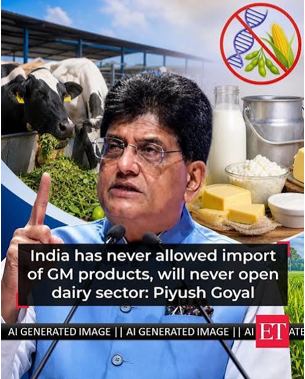
Union Commerce Minister Piyush Goyal stated India will not allow imports of Genetically Modified (GM) products or dairy processed using calf rennet during US trade talks, while asserting local manufacturing capabilities if China restricts Tunnel Boring Machines (TBMs).
Background
• US Dairy & GM Pressure: The Office of the United States Trade Representative (USTR) labeled India’s strict non-GM certification and non-ruminant feed requirements for dairy imports as non-tariff barriers.
• Cultural & Health Sensitivity: India strictly mandates that dairy imports derive exclusively from animals fed non-animal-origin diets, excluding calf rennet, blood meal, or tissue feeds.
• Strategic Manufacturing Lessons: Amid Chinese export curbs on critical technologies (like rare earth elements or TBMs), India prioritizes domestic indigenization via startups and indigenous industrial manufacturing.
• Key Facts: o India is the world\'s largest milk producer, contributing over 24% to global production. o Bt Cotton remains the only GM crop commercially approved for cultivation in India (2002).
Impact & Measures
• Major Implications & Challenges:
o Livelihood Protection: Protecting the domestic dairy sector safeguards millions of small and marginal dairy farmers from cheap foreign imports.
o Biosecurity & Public Trust: Strict GM import controls mitigate potential ecological hazards and address sociocultural sensitivities surrounding livestock feed.
o Trade Negotiations Friction: Stiff non-tariff compliance creates deadlocks in free trade agreement (FTA) negotiations with developed nations like the US.
o Supply Chain Risks: Over-reliance on China for specialized heavy equipment (e.g., TBMs for infrastructure) exposes mega-projects to geopolitical tensions.
• Government Initiatives & Solutions: o Promote domestic R&D and startup innovation to indigenize critical capital equipment (TBMs, rare-earth motors).
o Enforce mandatory non-GM origin certificates issued by exporting countries\' official authorities for food import consignments.
Essential Definitions
• Genetically Modified (GM) Organisms: Organisms whose genetic material (DNA) has been altered using genetic engineering techniques to introduce desired traits.
• Non-Tariff Barriers (NTBs): Trade restrictions such as quotas, certifications, and technical regulations that limit imports without directly applying tariffs.
Legal and Constitutional Framework
• Environment Protection Act (EPA), 1986: Rules 1989 regulate the manufacture, use, import, export, and storage of hazardous microorganisms/genetically engineered organisms.
• Food Safety and Standards Act (FSSAI), 2006: Mandates safety standards and non-GM certification for food imports into India.
• Foreign Trade (Development and Regulation) Act, 1992: Empowers the Central Government to formulate and enforce foreign trade policy and import restrictions.
Conclusion India refusal to compromise on GM imports and dairy protections balances domestic food security with economic sovereignty. Pushing for local manufacturing capacity for high-tech industrial assets further strengthens national resilience against global supply disruptions.


Address : 506, 3rd EYE THREE (III), Opp. Induben Khakhrawala, Girish Cold Drink Cross Road, CG Road, Navrangpura, Ahmedabad, 380009.
Mobile : 8469231587 / 9586028957
E-mail: dics.upsc@gmail.com
Address: A-306, The Landmark, Urjanagar-1, Opp. Spicy Street, Kudasan – Por Road, Kudasan, Gandhinagar – 382421
Mobile : 9723832444 / 9723932444
E-mail: dics.gnagar@gmail.com
Address: Tithi Commercial Complex, 401/402 Productivity Road, Opp. Productivity House, Alkapuri, Vadodara, Gujarat – 390007
Mobile : 9725692037 / 9725692054
E-mail: dics.vadodara@gmail.com
Address: 403, Raj Victoria, Opp. Pal Walkway, Near Galaxy Circle, Pal, Surat-394510
Mobile : 8401031583 / 8401031587
E-mail: dics.surat@gmail.com
Address: 303,305 K 158 Complex Above Magson, Sindhubhavan Road Ahmedabad-380059
Mobile : 9974751177 / 8469231587
E-mail: dicssbr@gmail.com
Address: 57/17, 2nd Floor, Old Rajinder Nagar Market, Bada Bazaar Marg, Delhi-60
Mobile : 9104830862 / 9104830865
E-mail: dics.newdelhi@gmail.com