



Ahmedabad
(Head Office)Address : 506, 3rd EYE THREE (III), Opp. Induben Khakhrawala, Girish Cold Drink Cross Road, CG Road, Navrangpura, Ahmedabad, 380009.
Mobile : 8469231587 / 9586028957
E-mail: dics.upsc@gmail.com

UPSC Relevance GS Paper III: Environment, Ecology, Climate Change Negotiations, and Sustainable Development.
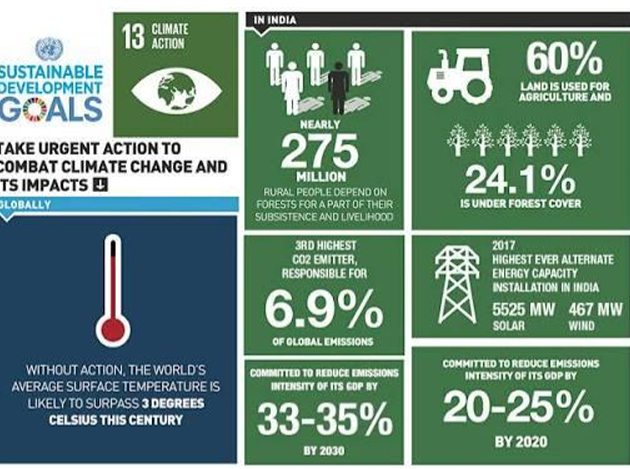
Why in News Ahead of COP31 in Antalya, Türkiye, India stated that global climate targets must respect national sovereignty and economic realities. India hasn\'t pledged support for the proposed 35 by 2035 electrification target.
Background
• COP31 Proposals: Host nation Türkiye proposed halving global waste growth by 2035, cutting building sector energy intensity by 25%, and achieving 35% global electrification by 2035.
• CBDR-RC Principle: Established under the 1992 UNFCCC, Common But Differentiated Responsibilities and Respective Capabilities recognizes historical emissions of developed nations while granting developing nations policy space for growth.
• Energy Access Imperative: India prioritizes energy security and poverty alleviation, making an immediate fossil fuel phase-out unfeasible. Impact & Measures
• Major Implications & Challenges:
o Top-down, uniform global targets risk undermining developing nations socio-economic development and poverty eradication goals.
o Rapid fossil fuel phase-out without affordable tech alternatives endangers energy security for low-income populations.
o Developed nations continuously fail to meet historical climate finance obligations.
• Government Initiatives:
o Updated NDCs target 50% cumulative electric power capacity from non-fossil sources by 2030 and 45% reduction in GDP emission intensity.
o Advocacy for climate justice, domestic renewable expansion (PLI for solar/acc), and National Green Hydrogen Mission.
• Possible Solutions: o Operationalize the Climate Finance Work Programme at COP31 to enforce accountable financial transfers. o Ensure voluntary agendas stay separate from binding core negotiations.
Essential Definitions
• CBDR-RC: A UNFCCC principle acknowledging nations\' varying capabilities and historical responsibilities in addressing climate change.
• Electrification Target: The proposed proportion of total global energy demand served directly by electricity to cut emissions.
Legal and Constitutional Framework
• Article 48A: Directs the State to protect and improve the environment and safeguard forests and wildlife. • Article 51(c): Fosters respect for international law and treaty obligations.
• Paris Agreement (2015): Legally binding international treaty on climate change based on bottom-up Nationally Determined Contributions (NDCs).
Conclusion India reiterates that global climate action must balance ambition with equity. Fulfilling climate finance promises by developed nations is indispensable for an equitable global green transition.


Address : 506, 3rd EYE THREE (III), Opp. Induben Khakhrawala, Girish Cold Drink Cross Road, CG Road, Navrangpura, Ahmedabad, 380009.
Mobile : 8469231587 / 9586028957
E-mail: dics.upsc@gmail.com
Address: A-306, The Landmark, Urjanagar-1, Opp. Spicy Street, Kudasan – Por Road, Kudasan, Gandhinagar – 382421
Mobile : 9723832444 / 9723932444
E-mail: dics.gnagar@gmail.com
Address: Tithi Commercial Complex, 401/402 Productivity Road, Opp. Productivity House, Alkapuri, Vadodara, Gujarat – 390007
Mobile : 9725692037 / 9725692054
E-mail: dics.vadodara@gmail.com
Address: 403, Raj Victoria, Opp. Pal Walkway, Near Galaxy Circle, Pal, Surat-394510
Mobile : 8401031583 / 8401031587
E-mail: dics.surat@gmail.com
Address: 303,305 K 158 Complex Above Magson, Sindhubhavan Road Ahmedabad-380059
Mobile : 9974751177 / 8469231587
E-mail: dicssbr@gmail.com
Address: 57/17, 2nd Floor, Old Rajinder Nagar Market, Bada Bazaar Marg, Delhi-60
Mobile : 9104830862 / 9104830865
E-mail: dics.newdelhi@gmail.com