
Ahmedabad
(Head Office)Address : 506, 3rd EYE THREE (III), Opp. Induben Khakhrawala, Girish Cold Drink Cross Road, CG Road, Navrangpura, Ahmedabad, 380009.
Mobile : 8469231587 / 9586028957
E-mail: dics.upsc@gmail.com

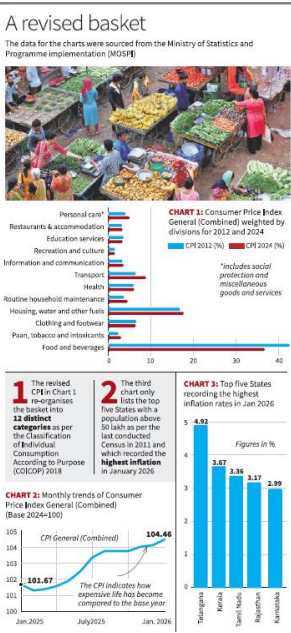
The recent revision of the Consumer Price Index (CPI) with 2024 as the new base year marks a significant shift in India\'s macroeconomic monitoring, aligning inflation data with the contemporary consumption patterns of Indian households.• Modernized Basket Composition: The updated CPI adopts the Classification of Individual Consumption According to Purpose (COICOP) 2018, expanding the basket from six to 12 distinct categories to provide granular visibility into household expenditure. • Structural Weight Shift: Reflecting the \'Engel’s Law\' progression in the Indian economy, the weight of food has been reduced while the shares of housing and services—including health, education, and transport—have increased significantly. • Service-Driven Inflation Signals: In states like Telangana, Kerala, and Tamil Nadu, higher inflation figures (e.g., Telangana at 5%) now more accurately reflect rising costs in the services sector rather than just transitory food price shocks. • Inclusion of Rural Housing: A major methodological correction in CPI 2024 is the explicit inclusion of rural housing and utilities, which addresses previous understatements of non-food inflation in states like Rajasthan. • Improved Monetary Policy Input: By isolating \'sticky\' service inflation from volatile food prices, the new index allows the Reserve Bank of India (RBI) to better distinguish between transitory and persistent price pressures for interest-rate decisions. • Clarifying Index vs. Rate: The revision reinforces the distinction between the CPI (a price level indicator relative to the 2024 base of 100) and the inflation rate (the year-on-year pace of price changes), ensuring more accurate public and policy discourse. Key Definitions • Consumer Price Index (CPI): A measure that examines the weighted average of prices of a basket of consumer goods and services, used to assess price changes associated with the cost of living. • Base Year: The benchmark year against which the price levels of other years are compared. The current revision has moved the base year from 2012 to 2024. • Household Consumption Expenditure Survey (HCES): A survey conducted by the National Sample Survey Office (NSSO) that provides the data used to determine the weights of various items in the CPI basket. • Headline Inflation: The total inflation within an economy, including commodities such as food and energy prices, which tend to be much more volatile. Constitutional and Legal Provisions • Article 246 (Seventh Schedule): Statistics, including the collection of price data and inflation monitoring, falls under the Concurrent List (Entry 45), allowing both the Union and States to engage in data collection, though the National Statistical Office (NSO) handles national CPI. • RBI Act, 1934 (2016 Amendment): Provides a statutory basis for the Flexible Inflation Targeting (FIT) framework. The RBI is mandated to maintain CPI inflation at 4% with a tolerance band of +/-2%.• Collection of Statistics Act, 2008: The legal framework under which the HCES and other price collection activities are conducted to ensure data reliability and respondent cooperation. Additional Strategic Keypoints • Correction of \'Weight Bias\': The older 2012 base was criticized for over-representing food, which led to policy \'over-reactions\' when seasonal crop failures caused temporary spikes. • Convergence of Rural-Urban Spending: HCES data indicates that rural consumption is increasingly mirroring urban patterns, with higher spending on processed foods and services, a reality now captured by the 2024 base. • Impact on Dearness Allowance (DA): Significant for GS-III (Economy) as CPI changes directly affect the cost-of-living adjustments for government employees and the calculation of the real GDP. Conclusion The transition to CPI 2024 is a vital \'statistical recalibration\' that reflects the maturation of the Indian economy. By shifting focus toward services and housing, the new index provides a more realistic \'cost-of-living\' metric. This transparency is crucial for the RBI to maintain price stability without stifling growth, ensuring that monetary interventions are based on persistent economic trends rather than short-term volatility in the vegetable markets. UPSC Relevance • General Studies III: Indian Economy and issues relating to planning, mobilization of resources, growth, development, and employment; Inflationary trends and monetary policy. • General Studies II: Statutory, regulatory, and various quasi-judicial bodies (NSO, RBI, Monetary Policy Committee). • Context: This update is a high-priority topic for Prelims (conceptual clarity on CPI vs. WPI) and Mains (evaluating the effectiveness of inflation targeting in India).


Address : 506, 3rd EYE THREE (III), Opp. Induben Khakhrawala, Girish Cold Drink Cross Road, CG Road, Navrangpura, Ahmedabad, 380009.
Mobile : 8469231587 / 9586028957
E-mail: dics.upsc@gmail.com
Address: A-306, The Landmark, Urjanagar-1, Opp. Spicy Street, Kudasan – Por Road, Kudasan, Gandhinagar – 382421
Mobile : 9723832444 / 9723932444
E-mail: dics.gnagar@gmail.com
Address: 2nd Floor, 9 Shivali Society, L&T Circle, opp. Ratri Bazar, Karelibaugh, Vadodara, 390018
Mobile : 9725692037 / 9725692054
E-mail: dics.vadodara@gmail.com
Address: 403, Raj Victoria, Opp. Pal Walkway, Near Galaxy Circle, Pal, Surat-394510
Mobile : 8401031583 / 8401031587
E-mail: dics.surat@gmail.com
Address: 303,305 K 158 Complex Above Magson, Sindhubhavan Road Ahmedabad-380059
Mobile : 9974751177 / 8469231587
E-mail: dicssbr@gmail.com
Address: 57/17, 2nd Floor, Old Rajinder Nagar Market, Bada Bazaar Marg, Delhi-60
Mobile : 9104830862 / 9104830865
E-mail: dics.newdelhi@gmail.com