


Ahmedabad
(Head Office)Address : 506, 3rd EYE THREE (III), Opp. Induben Khakhrawala, Girish Cold Drink Cross Road, CG Road, Navrangpura, Ahmedabad, 380009.
Mobile : 8469231587 / 9586028957
Telephone : 079-40098991
E-mail: dics.upsc@gmail.com

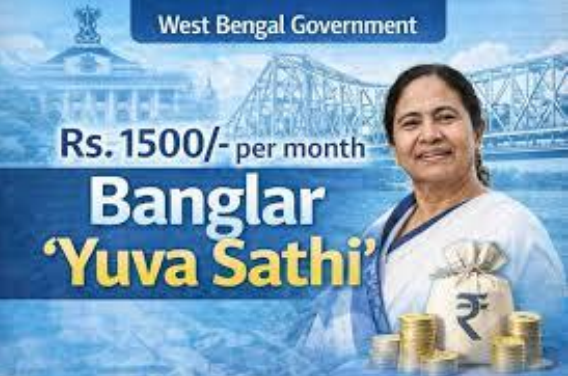
The emergence of \'lining up\' as a structural feature of Indian democracy highlights the increasing reliance of the citizenry on direct benefit transfers (DBT) and state-led social safety nets amidst a challenging employment landscape. • Banglar Yuva Sathi Scheme: Introduced in the 2026-27 State Budget, this unemployment assistance program targets youth aged 21-40 who have passed Class 10. It provides a monthly stipend of 1,500 until employment is secured or for a maximum of five years. • Massive Registration Surge: Within days of its announcement, millions have queued at camps like Geetanjali Stadium. The scale of applicants, including MBAs and postgraduates, underscores the severity of the \'underemployment\' crisis where highly qualified individuals seek basic sustenance aid. • Shift Towards Populist Transfers: The scheme follows the template of \'Lakshmir Bhandar\' (for women), signaling a governance shift toward cash incentives. While providing immediate liquidity to households, it raises questions about long-term capital expenditure versus revenue expenditure on doles. • Contractualization of Public Services: The state budget also hiked wages for over 1.25 lakh \'civic volunteers\' and \'village police.\' Critics argue this promotes a \'contractual force\' lacking the rigorous training and accountability of permanent cadres, citing security concerns like the 2024 R.G. Kar Hospital incident.• Political Economy of Patronage: Analysts suggest that ad-hoc and contractual appointments, often lacking transparent recruitment processes, may be used to build local political loyalties, potentially blurring the line between state administration and party machinery. • Sustainability and Job Creation: While the 5,000 crore allocation provides temporary relief, the opposition and economists highlight a \'job jobless growth\' trap, where cash transfers are prioritized over structural industrial investment and permanent employment generation. Key Definitions • Unemployment Allowance: A social security benefit paid by the state to unemployed individuals who are registered with the government and actively seeking work. • Direct Benefit Transfer (DBT): A mechanism to transfer subsidies or cash directly into the bank accounts of beneficiaries, aimed at reducing leakages and ensuring transparency. • Underemployment: A situation where an individual is employed but in a job that is under-utilizing their skills, or is part-time when they desire full-time work. Constitutional and Legal Context • Article 41 (DPSP): The Constitution mandates that the State shall, within the limits of its economic capacity, make effective provision for securing the right to work, to education, and to public assistance in cases of unemployment. • Seventh Schedule: \'Social security and social insurance; employment and unemployment\' falls under the Concurrent List (Entry 23), allowing both Centre and States to legislate and launch schemes. • Fiscal Responsibility and Budget Management (FRBM) Act: States must balance welfare spending (revenue expenditure) with fiscal deficit targets to ensure long-term economic stability. Additional Strategic Keypoints • The \'Dole\' vs. \'Development\' Debate: Constant reliance on cash transfers can create a fiscal burden that crowds out investment in infrastructure, health, and education. • Gendered Impact of Welfare: Schemes like Lakshmir Bhandar have historically shown high electoral returns by creating a dedicated \'women’s vote bank\' through financial empowerment. • Security Implications of Civic Volunteers: The use of semi-trained volunteers in sensitive sectors like policing raises legal questions regarding sovereign functions and the liability of the state for their actions. Conclusion The \'Banglar Yuva Sathi\' scheme reflects a broader national trend where state governments utilize cash transfers as a primary tool for social mitigation. While these measures offer a vital safety net for the vulnerable, they are often symptomatic of a deeper crisis in the formal labor market. For sustainable growth, such \'stopgap\' financial aid must be complemented by robust industrial policies that transition the youth from being \'beneficiaries\' to \'productive contributors\' to the economy. UPSC Relevance • General Studies II: Issues relating to development and management of Social Sector/Services relating to Human Resources; Welfare schemes for vulnerable sections of the population.• General Studies III: Indian Economy and issues relating to planning, mobilization of resources, growth, development, and employment. • Context: Essential for understanding the \'Welfare State\' vs. \'Freebie Culture\' debate frequently asked in Mains and Personality Tests.


Address : 506, 3rd EYE THREE (III), Opp. Induben Khakhrawala, Girish Cold Drink Cross Road, CG Road, Navrangpura, Ahmedabad, 380009.
Mobile : 8469231587 / 9586028957
Telephone : 079-40098991
E-mail: dics.upsc@gmail.com
Address: A-306, The Landmark, Urjanagar-1, Opp. Spicy Street, Kudasan – Por Road, Kudasan, Gandhinagar – 382421
Mobile : 9723832444 / 9723932444
E-mail: dics.gnagar@gmail.com
Address: 2nd Floor, 9 Shivali Society, L&T Circle, opp. Ratri Bazar, Karelibaugh, Vadodara, 390018
Mobile : 9725692037 / 9725692054
E-mail: dics.vadodara@gmail.com
Address: 403, Raj Victoria, Opp. Pal Walkway, Near Galaxy Circle, Pal, Surat-394510
Mobile : 8401031583 / 8401031587
E-mail: dics.surat@gmail.com
Address: 303,305 K 158 Complex Above Magson, Sindhubhavan Road Ahmedabad-380059
Mobile : 9974751177 / 8469231587
E-mail: dicssbr@gmail.com
Address: 57/17, 2nd Floor, Old Rajinder Nagar Market, Bada Bazaar Marg, Delhi-60
Mobile : 9104830862 / 9104830865
E-mail: dics.newdelhi@gmail.com