
Ahmedabad
(Head Office)Address : 506, 3rd EYE THREE (III), Opp. Induben Khakhrawala, Girish Cold Drink Cross Road, CG Road, Navrangpura, Ahmedabad, 380009.
Mobile : 8469231587 / 9586028957
E-mail: dics.upsc@gmail.com

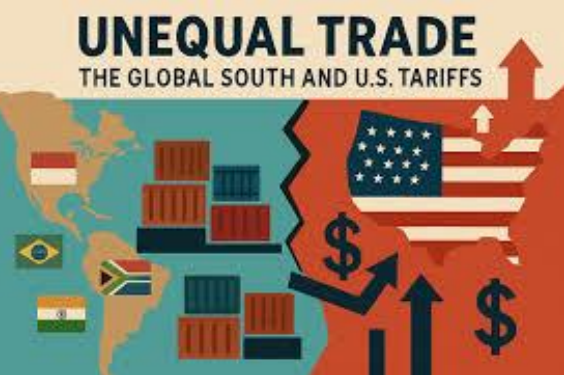
President Luiz Inacio Lula da Silva’s call for a \'negotiating bloc\' reflects a strategic shift in international trade diplomacy, urging developing nations to leverage collective bargaining against unilateral protectionism. • Collective Bargaining in Trade: President Lula advocates for the \'unionisation\' of nations facing high tariffs, arguing that individual negotiations between smaller economies and superpowers like the U.S. result in inherently lopsided and harmful agreements. • Rejection of a New Cold War: Brazil emphasizes a multipolar world order, explicitly stating a desire to avoid new bloc-based hostilities while demanding equal treatment and non-interference in the sovereign trade choices of Global South nations. • Impact of Unilateral Tariffs: Both India and Brazil have been significantly impacted by U.S. trade policies, facing up to 50% duties on specific exports, which Lula views as a tool of economic coercion rather than fair market competition. • BRICS and Geopolitical Autonomy: The call for unity is heightened by threats of tariffs linked to BRICS membership, trade with Iran, and Russian oil imports, highlighting the tension between national strategic autonomy and global trade dependencies. • The Trade Union Model: Drawing on his background as a labor leader, Lula applies the \'employer-worker\' dynamic to geopolitics, suggesting that only through a \'united front\' can developing nations confront the policy shifts of global superpowers effectively. • Sovereignty vs. Protectionism: The core of the argument rests on the principle that international trade should not be used as a weapon to dictate the domestic or foreign policies of sovereign states. Key Definitions • Tariffs: Custom duties or taxes imposed by a government on imported goods, often used as a protectionist tool to make foreign products less competitive. • Global South: A term used to describe developing, emerging, or lower-income nations, primarily located in Africa, Asia, and Latin America, often sharing a history of colonialism and seeking reform in global governance. • Negotiating Bloc: A group of countries that coordinate their positions and act as a single entity in international negotiations to increase their collective influence and leverage. Constitutional and Legal Context • Article 51 (India): The Directive Principles of State Policy (DPSP) mandate that the State shall endeavor to promote international peace, maintain just and honorable relations between nations, and foster respect for international law and treaty obligations.• WTO Principles: The World Trade Organization (WTO) promotes \'Most-Favored-Nation\' (MFN) status, which prohibits discrimination between trading partners. Unilateral high tariffs often challenge the spirit of these multilateral trade rules. • Enabling Clause (1979): Under GATT/WTO, this allows developed countries to give differential and more favorable treatment to developing countries, a principle currently under pressure from protectionist policies. Additional Strategic Keypoints • India-Brazil Synergy: As key members of G4, IBSA, and BRICS, both nations share a common interest in reforming the UN Security Council and the global financial architecture. • Counter-Coercion: The formation of a trade bloc serves as a \'shield\' against \'secondary sanctions\' or trade penalties imposed for engaging with countries outside the Western-led financial system. • Supply Chain Resilience: Collaborative negotiating blocs can help secure critical supply chains for the Global South, reducing dependence on single-market superpowers. Conclusion President Lula’s proposal marks a transition from passive participation in global trade to active, collective resistance against economic unilateralism. By likening international diplomacy to trade unionism, he underscores the necessity of solidarity among Global South nations to ensure that \'equality\' in trade is not just a rhetorical device but a functional reality. For India, this aligns with its \'Vishwa Bandhu\' (Global Friend) approach, balancing its strategic partnership with the U.S. while leading the voice of the developing world. UPSC Relevance • General Studies II: International Relations (Bilateral, regional, and global groupings involving India); Effect of policies of developed countries on India\'s interests. • General Studies III: Indian Economy (Changes in industrial policy and their effects on industrial growth); International Trade and WTO. • Context: This topic is crucial for understanding the evolving dynamics of the North-South divide and India’s leadership role in the Global South.


Address : 506, 3rd EYE THREE (III), Opp. Induben Khakhrawala, Girish Cold Drink Cross Road, CG Road, Navrangpura, Ahmedabad, 380009.
Mobile : 8469231587 / 9586028957
E-mail: dics.upsc@gmail.com
Address: A-306, The Landmark, Urjanagar-1, Opp. Spicy Street, Kudasan – Por Road, Kudasan, Gandhinagar – 382421
Mobile : 9723832444 / 9723932444
E-mail: dics.gnagar@gmail.com
Address: Tithi Commercial Complex, 401/402 Productivity Road, Opp. Productivity House, Alkapuri, Vadodara, Gujarat – 390007
Mobile : 9725692037 / 9725692054
E-mail: dics.vadodara@gmail.com
Address: 403, Raj Victoria, Opp. Pal Walkway, Near Galaxy Circle, Pal, Surat-394510
Mobile : 8401031583 / 8401031587
E-mail: dics.surat@gmail.com
Address: 303,305 K 158 Complex Above Magson, Sindhubhavan Road Ahmedabad-380059
Mobile : 9974751177 / 8469231587
E-mail: dicssbr@gmail.com
Address: 57/17, 2nd Floor, Old Rajinder Nagar Market, Bada Bazaar Marg, Delhi-60
Mobile : 9104830862 / 9104830865
E-mail: dics.newdelhi@gmail.com