


Ahmedabad
(Head Office)Address : 506, 3rd EYE THREE (III), Opp. Induben Khakhrawala, Girish Cold Drink Cross Road, CG Road, Navrangpura, Ahmedabad, 380009.
Mobile : 8469231587 / 9586028957
Telephone : 079-40098991
E-mail: dics.upsc@gmail.com

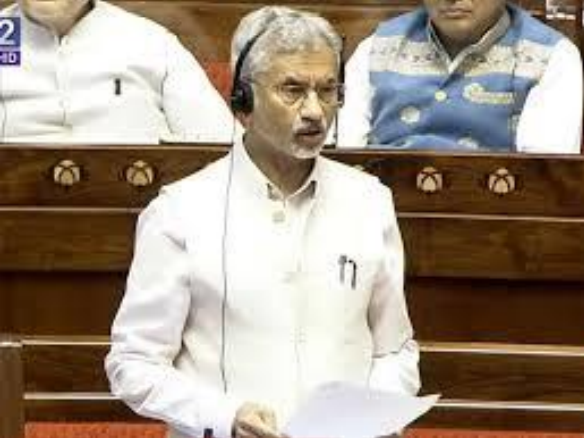
• Overriding Priority of Human Safety: External Affairs Minister S. Jaishankar emphasized that the protection and evacuation of Indian nationals in the conflict zone remains the government\'s foremost objective, given the high concentration of the Indian diaspora in West Asia. • Strategic Energy and Trade Interests: Ensuring the continuity of energy security and unhindered trade flows remains a \'paramount\' interest, especially as regional instability threatens maritime routes and oil supply chains vital to the Indian economy. • Engagement with New Leadership: Following the death of Ayatollah Ali Khamenei in a U.S.-Israel strike, India is seeking to establish high-level contact with the newly appointed Supreme Leader, Mojtaba Khamenei, to ensure diplomatic continuity. • Complex Maritime Diplomacy: The Minister revealed that Iran had requested docking permissions for naval ships prior to the sinking of the IRIS Dena near Sri Lanka, highlighting the precarious nature of maritime security in the Indian Ocean Region (IOR). • Bilateral and Multilateral Balancing: India is maintaining active communication with both the U.S. and Iran, reflecting its \'Strategic Autonomy\' approach—balancing its partnership with Washington while maintaining traditional ties with Tehran. • Leadership Transition in Iran: The appointment of 57-year-old Mojtaba Khamenei by the Assembly of Experts marks a significant shift in the Islamic Republic’s hierarchy, potentially impacting the geopolitical orientation of the region. Key Definitions • Suo Motu Statement: A Latin term meaning \'on its own motion\'; in Parliament, it refers to a statement made by a Minister on a matter of urgent public importance without being prompted by a question. • Strategic Autonomy: A foreign policy doctrine where a nation makes decisions based on its own national interests without being unduly influenced by other states or being part of formal military alliances. • Assembly of Experts: A powerful Iranian body of 88 clerics responsible for appointing, supervising, and—theoretically—dismissing the Supreme Leader. Constitutional & Legal Framework • Article 73: Specifies the extent of the executive power of the Union, which includes entering into treaties and agreements with foreign countries and representing India internationally. • Entry 10, List I (Seventh Schedule): Grants the Union Parliament exclusive power over \'Foreign Affairs; all matters which bring the Union into relation with any foreign country.\' • Entry 14, List I (Seventh Schedule): Power to enter into and implement treaties, agreements, and conventions with foreign countries. • Passports Act, 1967: The legal basis for the government\'s obligation to assist and protect Indian citizens abroad during crises. Additional Important Keypoints • Evacuation History: India has a robust track record of \'Vande Bharat\' style missions (e.g., Operation Ganga, Operation Kaveri) which serve as the template for potential actions in West Asia. • The \'Hormuz\' Factor: With 1/5th of global oil passing through the Strait of Hormuz, India\'s diplomatic outreach is essential to prevent a total blockade that would spike domestic inflation. • Security in IOR: The torpedoing of IRIS Dena off Sri Lanka indicates the conflict has spilled into India\'s immediate maritime neighborhood, necessitating heightened vigil by the Indian Navy. Conclusion India’s diplomatic maneuvering amidst the Iran-Israel-U.S. escalation reflects a pragmatic blend of \'Realpolitik\' and humanitarian concern. By prioritizing the safety of its diaspora and the stability of energy corridors while navigating a transition in Iranian leadership, New Delhi aims to insulate its domestic economy from a volatile external environment. The situation underscores the necessity of maintaining \'Multi-alignment\' in an increasingly polarized global order. UPSC Relevance • GS Paper II: Bilateral, regional, and global groupings and agreements involving India and/or affecting India’s interests; Effect of policies and politics of developed and developing countries on India’s interests; Indian Diaspora. • GS Paper III: Security challenges and their management in border areas; Linkages of organized crime with terrorism (maritime security). • Prelims: Geography of West Asia (Strait of Hormuz, Persian Gulf), Constitutional provisions regarding Foreign Affairs, and International Relations terminology.


Address : 506, 3rd EYE THREE (III), Opp. Induben Khakhrawala, Girish Cold Drink Cross Road, CG Road, Navrangpura, Ahmedabad, 380009.
Mobile : 8469231587 / 9586028957
Telephone : 079-40098991
E-mail: dics.upsc@gmail.com
Address: A-306, The Landmark, Urjanagar-1, Opp. Spicy Street, Kudasan – Por Road, Kudasan, Gandhinagar – 382421
Mobile : 9723832444 / 9723932444
E-mail: dics.gnagar@gmail.com
Address: 2nd Floor, 9 Shivali Society, L&T Circle, opp. Ratri Bazar, Karelibaugh, Vadodara, 390018
Mobile : 9725692037 / 9725692054
E-mail: dics.vadodara@gmail.com
Address: 403, Raj Victoria, Opp. Pal Walkway, Near Galaxy Circle, Pal, Surat-394510
Mobile : 8401031583 / 8401031587
E-mail: dics.surat@gmail.com
Address: 303,305 K 158 Complex Above Magson, Sindhubhavan Road Ahmedabad-380059
Mobile : 9974751177 / 8469231587
E-mail: dicssbr@gmail.com
Address: 57/17, 2nd Floor, Old Rajinder Nagar Market, Bada Bazaar Marg, Delhi-60
Mobile : 9104830862 / 9104830865
E-mail: dics.newdelhi@gmail.com