
Ahmedabad
(Head Office)Address : 506, 3rd EYE THREE (III), Opp. Induben Khakhrawala, Girish Cold Drink Cross Road, CG Road, Navrangpura, Ahmedabad, 380009.
Mobile : 8469231587 / 9586028957
E-mail: dics.upsc@gmail.com

Key Highlights & Summary
• The World Health Organization (WHO) has issued new guidelines on expanding contraceptive options and, for the first time, set benchmarks for a new generation of reversible male contraceptives. The timing is significant for India, where fertility has already fallen below the replacement level.
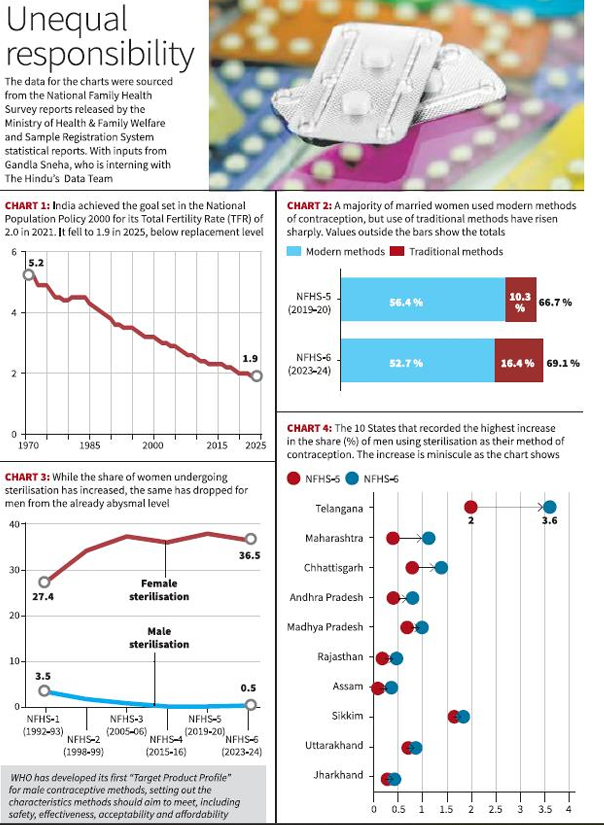
• NFHS-6 (2023-24) shows that the unmet need for family planning among married women fell by one percentage point from NFHS-5 (2019-21). The use of any contraceptive method among currently married women aged 15-49 rose from 66.7% to 69.1%.
• The use of modern methods declined from 56.4% to 52.7%, while traditional methods (rhythm and withdrawal) rose by 6 percentage points, the largest rise in any method. Possible reasons include fear of side-effects, privacy, partner preferences, access issues and a desire to avoid hormonal or invasive methods.
• Sterilisation remains overwhelmingly female. Female sterilisation stood at 36.5% in NFHS-6 (37.9% in NFHS-5), against only 0.5% for male sterilisation (0.3% in NFHS-5). Female sterilisation has remained at about 36-38% since NFHS-3, while male sterilisation fell from 3.4% in NFHS-1 to 0.5%.
• Even States that achieved low Total Fertility Rate early were no exception. Male sterilisation rose in 22 States between NFHS-5 and NFHS-6, but no State except Telangana recorded a rise of more than one percentage point. Vasectomy has moved from a visible component of family planning to a marginal one, though it is less invasive and can be done under local anaesthesia.
• Pascale Allotey of WHO said that choice is a gender equality issue. WHO research has challenged the long-held assumption that men would not use new contraceptives, and India can use the guidelines to correct the imbalance.
Essential Definitions
• Total Fertility Rate (TFR): Average number of children a woman would bear in her lifetime, given current age-specific fertility rates.
• Replacement level fertility: A TFR of about 2.1, at which a population replaces itself without migration.
• Unmet need for family planning: Share of women who want to delay or stop childbearing but do not use any contraception.
• Vasectomy and tubectomy: Permanent methods of male and female sterilisation respectively.
• Modern and traditional methods: Modern methods include pills, condoms, IUDs and sterilisation. Traditional methods include rhythm and withdrawal, which have higher failure rates.
Legal and Constitutional Framework
• Article 21: Right to life and personal liberty, including reproductive choice and bodily autonomy (Suchita Srivastava v. Chandigarh Administration, 2009).
• Article 14 and Article 15(3): Equality before law and special provisions for women.
• Article 47: Duty of the State to improve public health.
• Entry 20A, Concurrent List (Seventh Schedule): Population control and family planning.
• Devika Biswas v. Union of India (2016): The Supreme Court condemned sterilisation camps and directed safe, voluntary and informed practices.
• National Health Policy, 2017, and National Population Policy, 2000: Emphasise voluntary and informed choice, and promote male participation.
• Related schemes: Mission Parivar Vikas, Antara injectable contraceptive, and the Family Planning Indemnity Scheme.
• Vasectomy Fortnight and compensation for sterilisation acceptors: Efforts to encourage male participation.
Conclusion India\'s demographic success has not translated into shared contraceptive responsibility. The burden still falls on women, reflecting social norms, misconceptions and weak male outreach. Male-focused counselling, better service delivery, a wider method mix and the new WHO benchmarks can shift the approach towards equitable, voluntary and rights-based family planning.
UPSC Relevance
• Prelims: NFHS, TFR, replacement level fertility, unmet need, Mission Parivar Vikas, Antara, Entry 20A.
• Mains GS-I: Population and associated issues, role of women, social empowerment and gender roles.
• Mains GS-II: Health, government policies for vulnerable sections, and women-centric issues.
• Mains GS-IV: Ethics of choice, consent and gender justice.
• Essay and Interview: Themes like \'Reproductive rights and gender equality\' and \'Population stabilisation and shared responsibility\'.


Address : 506, 3rd EYE THREE (III), Opp. Induben Khakhrawala, Girish Cold Drink Cross Road, CG Road, Navrangpura, Ahmedabad, 380009.
Mobile : 8469231587 / 9586028957
E-mail: dics.upsc@gmail.com
Address: A-306, The Landmark, Urjanagar-1, Opp. Spicy Street, Kudasan – Por Road, Kudasan, Gandhinagar – 382421
Mobile : 9723832444 / 9723932444
E-mail: dics.gnagar@gmail.com
Address: Tithi Commercial Complex, 401/402 Productivity Road, Opp. Productivity House, Alkapuri, Vadodara, Gujarat – 390007
Mobile : 9725692037 / 9725692054
E-mail: dics.vadodara@gmail.com
Address: 403, Raj Victoria, Opp. Pal Walkway, Near Galaxy Circle, Pal, Surat-394510
Mobile : 8401031583 / 8401031587
E-mail: dics.surat@gmail.com
Address: 303,305 K 158 Complex Above Magson, Sindhubhavan Road Ahmedabad-380059
Mobile : 9974751177 / 8469231587
E-mail: dicssbr@gmail.com
Address: 57/17, 2nd Floor, Old Rajinder Nagar Market, Bada Bazaar Marg, Delhi-60
Mobile : 9104830862 / 9104830865
E-mail: dics.newdelhi@gmail.com