

Ahmedabad
(Head Office)Address : 506, 3rd EYE THREE (III), Opp. Induben Khakhrawala, Girish Cold Drink Cross Road, CG Road, Navrangpura, Ahmedabad, 380009.
Mobile : 8469231587 / 9586028957
E-mail: dics.upsc@gmail.com

Key Highlights & Summary
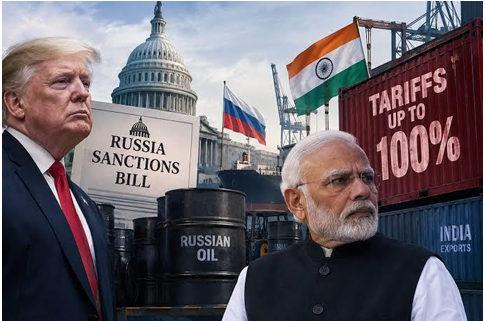
• U.S. Legislation Clearance: The U.S. House of Representatives passed legislation passed by a vote of 262-159 to target Russia’s energy sector, individuals, and shadow fleet tankers.
• 100% Tariff Provision: The legislation authorises the U.S. President to impose up to 100% tariffs on countries, including India, making new purchases of Russian crude oil and gas on or after 30 days of enactment.
• Targeting Top Importers: The bill specifically targets the top five largest importers of Russian energy by total volume over the preceding 12 months.
• India’s High Import Volume: Russian oil accounted for over 51% of India’s total crude imports in July, reaching an all-time high of 110.4 lakh tonnes.
• New Delhi’s Stance: The Ministry of External Affairs affirmed India’s firm commitment to protecting national interest and securing energy supplies for its 1.4 billion citizens through market-driven diversification.
• Presidential Waiver Mechanism: The U.S. President retains discretionary statutory authority under the legislation to waive sanction enforcement based on national interest imperatives.
Essential Definitions
• Shadow Fleet: Unregulated, older oil tanker vessels operating outside standard Western maritime insurance, flag registration, and financing structures to bypass energy sanctions.
• Secondary Sanctions: Penalties imposed by a nation-state against foreign third-party entities or countries for conducting economic transactions with sanctioned primary targets.
• Presidential Waiver Clause: A legal provision within U.S. sanctions laws empowering the executive branch to temporarily exempt foreign nations from penalties due to strategic priorities.
Legal and Constitutional Framework
• Lindsey O. Graham Sanctioning Russia and Iran Act of 2026: The parent U.S. legislative statute under which tariff mandates and energy trade sanctions are codified.
• Countering America\'s Adversaries Through Sanctions Act (CAATSA), 2017: Federal law providing a framework for secondary sanctions against trade entities dealing with targeted adversaries.
• Article 73 of the Indian Constitution: Extends executive power of the Union to international treaties, global trade negotiations, and external trade regulation policies.
Conclusion The proposed U.S. tariffs highlight growing geopolitical pressure on India\'s energy diplomacy. Maintaining strategic autonomy while securing affordable energy imports requires careful diplomatic engagement and economic adaptation to mitigate potential trade trade-offs.
UPSC Relevance
• GS Paper II (International Relations): India-U.S. bilateral ties, secondary sanctions impact on India\'s foreign policy, strategic autonomy, and global energy diplomacy.
• GS Paper III (Economy & Security): Energy security, import dependence, international supply chain disruptions, and global trade dynamics.


Address : 506, 3rd EYE THREE (III), Opp. Induben Khakhrawala, Girish Cold Drink Cross Road, CG Road, Navrangpura, Ahmedabad, 380009.
Mobile : 8469231587 / 9586028957
E-mail: dics.upsc@gmail.com
Address: A-306, The Landmark, Urjanagar-1, Opp. Spicy Street, Kudasan – Por Road, Kudasan, Gandhinagar – 382421
Mobile : 9723832444 / 9723932444
E-mail: dics.gnagar@gmail.com
Address: 2nd Floor, 9 Shivali Society, L&T Circle, opp. Ratri Bazar, Karelibaugh, Vadodara, 390018
Mobile : 9725692037 / 9725692054
E-mail: dics.vadodara@gmail.com
Address: 403, Raj Victoria, Opp. Pal Walkway, Near Galaxy Circle, Pal, Surat-394510
Mobile : 8401031583 / 8401031587
E-mail: dics.surat@gmail.com
Address: 303,305 K 158 Complex Above Magson, Sindhubhavan Road Ahmedabad-380059
Mobile : 9974751177 / 8469231587
E-mail: dicssbr@gmail.com
Address: 57/17, 2nd Floor, Old Rajinder Nagar Market, Bada Bazaar Marg, Delhi-60
Mobile : 9104830862 / 9104830865
E-mail: dics.newdelhi@gmail.com