





Ahmedabad
(Head Office)Address : 506, 3rd EYE THREE (III), Opp. Induben Khakhrawala, Girish Cold Drink Cross Road, CG Road, Navrangpura, Ahmedabad, 380009.
Mobile : 8469231587 / 9586028957
Telephone : 079-40098991
E-mail: dics.upsc@gmail.com

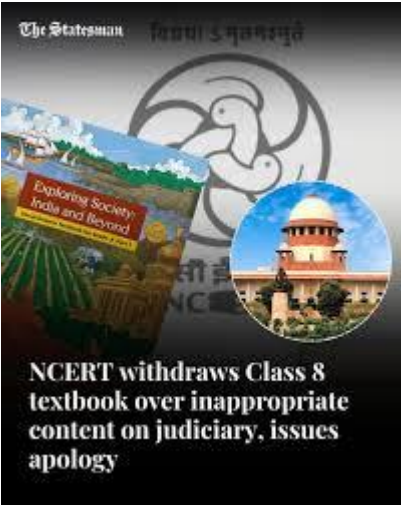
• Suo Motu Intervention: The Supreme Court of India, led by Chief Justice Surya Kant, has registered a suo motu case following reports that a new NCERT Class 8 Social Science textbook includes sections alleging \'corruption in the judiciary\'. • Judicial Stance on Institutional Defamation: Chief Justice Surya Kant took serious exception to the content, stating that the Court will not allow anyone to play with the integrity of the judiciary or defame the institution. • Textbook Challenges Listed: The new textbook specifically identifies \'corruption in the judiciary\' and \'massive backlog\' as significant challenges facing the Indian legal system. • Systemic Issues Noted by NCERT: The curriculum points to several hurdles, including a lack of an adequate number of judges, complicated legal procedures, and poor infrastructure as reasons for judicial delays. • Evolution of Content: The previous version of the textbook primarily described the role of the judiciary and the importance of an independent judicial system, whereas the new edition introduces critical views on judicial conduct. • Judicial Reaction: The CJI described the inclusion of such content as \'very calculated\' and \'deeprooted,\' indicating a concern that the curriculum might undermine public trust in the judicial branch. Key Definitions • Suo Motu: A Latin term meaning \'on its own motion.\' It refers to a situation where a court takes up a case on its own initiative without a formal petition being filed by a party. • NCERT: The National Council of Educational Research and Training, an autonomous organization that assists the Central and State Governments on policies and programmes for qualitative improvement in school education. • Defamation: The act of damaging the good reputation of someone or an institution; in this context, it refers to statements that may lower the dignity of the judiciary in the eyes of the public. Constitutional and Legal Provisions • Article 129: Grants the Supreme Court the power to punish for contempt of itself, which includes acts that scandalize or lower the authority of the court. • Article 142: Provides the Supreme Court with the power to pass any order necessary for doing \'complete justice\' in any cause or matter pending before it. • Independence of Judiciary: A \'Basic Structure\' of the Constitution (as per the Kesavananda Bharati case) which ensures the judiciary remains free from influence by the executive or legislature. • Contempt of Courts Act, 1971: Defines civil and criminal contempt, where \'criminal contempt\' includes scandalizing the court or interfering with the administration of justice. Additional Key Points • The \'Justice Delayed\' Concept: The textbook utilizes the phrase \'justice delayed is justice denied\' to characterize the extended time periods required for cases to be resolved in Indian courts. • Institutional Integrity: The core of the CJI\'s objection rests on the balance between academic freedom/critical thinking and the preservation of the sanctity of constitutional institutions. Conclusion: The conflict between the judiciary and educational content highlights the delicate balance between systemic criticism and institutional defamation. While addressal of judicial delays and infrastructural gaps is a recognized necessity, the attribution of \'corruption\' as a standard challenge in school textbooks has been viewed by the Supreme Court as a threat to judicial integrity. This case will likely define the boundaries of how state-sponsored educational materials can critique constitutional bodies. UPSC Relevance • GS Paper II: Structure, organization, and functioning of the Judiciary; Issues arising out of the design and implementation of policies; Issues relating to the development and management of Social Sector/Education. • Ethics (GS Paper IV): Institutional ethics and the role of education in shaping the perception of constitutional values and public trust. • Essay/Mains: Potential topic regarding \'Judicial Accountability vs. Judicial Independence\' or \'The Role of Education in Strengthening/Weakening Democracy.\'


Address : 506, 3rd EYE THREE (III), Opp. Induben Khakhrawala, Girish Cold Drink Cross Road, CG Road, Navrangpura, Ahmedabad, 380009.
Mobile : 8469231587 / 9586028957
Telephone : 079-40098991
E-mail: dics.upsc@gmail.com
Address: A-306, The Landmark, Urjanagar-1, Opp. Spicy Street, Kudasan – Por Road, Kudasan, Gandhinagar – 382421
Mobile : 9723832444 / 9723932444
E-mail: dics.gnagar@gmail.com
Address: 2nd Floor, 9 Shivali Society, L&T Circle, opp. Ratri Bazar, Karelibaugh, Vadodara, 390018
Mobile : 9725692037 / 9725692054
E-mail: dics.vadodara@gmail.com
Address: 403, Raj Victoria, Opp. Pal Walkway, Near Galaxy Circle, Pal, Surat-394510
Mobile : 8401031583 / 8401031587
E-mail: dics.surat@gmail.com
Address: 303,305 K 158 Complex Above Magson, Sindhubhavan Road Ahmedabad-380059
Mobile : 9974751177 / 8469231587
E-mail: dicssbr@gmail.com
Address: 57/17, 2nd Floor, Old Rajinder Nagar Market, Bada Bazaar Marg, Delhi-60
Mobile : 9104830862 / 9104830865
E-mail: dics.newdelhi@gmail.com