



Ahmedabad
(Head Office)Address : 506, 3rd EYE THREE (III), Opp. Induben Khakhrawala, Girish Cold Drink Cross Road, CG Road, Navrangpura, Ahmedabad, 380009.
Mobile : 8469231587 / 9586028957
Telephone : 079-40098991
E-mail: dics.upsc@gmail.com

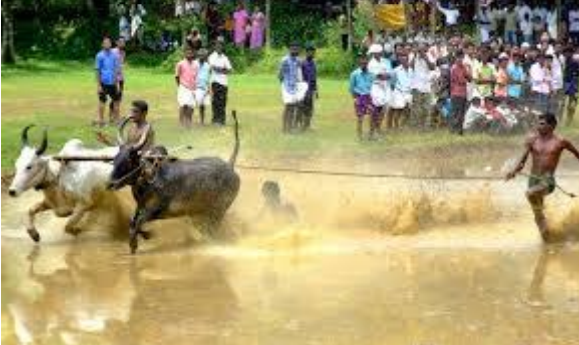
• Historical Significance: The Kakkur Kalavayal is a traditional post-harvest agricultural festival held in the Ernakulam district of Kerala. Historically, it served as a major trade hub for farmers to exchange seeds, cattle, and indigenous agricultural implements. • The Kalavayal (Cattle Race): A central attraction of the fair is the cattle race (maramadi), which showcases the strength and speed of local bovine breeds. These events are deeply rooted in the agrarian calendar, marking the transition between harvest and the next sowing season. • Agro-Biodiversity Promotion: The week-long fair acts as a platform for displaying indigenous cattle breeds and organic produce, encouraging farmers to move away from monoculture and preserve local genetic diversity in livestock. • Socio-Economic Integration: Beyond entertainment, the fair facilitates direct interaction between producers and consumers, reducing the role of middlemen and boosting the local rural economy through the sale of handicrafts, traditional food, and farm equipment. • Legal and Animal Welfare Balance: While being a celebrated tradition, the event is conducted under strict supervision to ensure compliance with judicial guidelines regarding the treatment of animals, reflecting the ongoing national dialogue between cultural rights and animal welfare. • Tourism and Soft Power: The festival has evolved into a significant cultural tourism event, attracting visitors from across the state and promoting Kerala’s \'living heritage\' and traditional agrarian lifestyles to a modern audience. Key Definitions and Concepts • Kalavayal: Literally translated to \'Cattle Market\' or \'Field of Bulls.\' It refers to traditional rural congregations where trade and festivities occur simultaneously. • Maramadi: A traditional form of cattle racing or bull surfing practiced in rural Kerala, typically in flooded paddy fields or dry agrarian tracts after the harvest. • Agro-ecology: A holistic approach to farming that integrates ecological principles with social and economic aspects of agricultural systems. Constitutional and Legal Provisions • Article 51-A(g): Mandates a Fundamental Duty to have compassion for living creatures, often cited in legal debates surrounding animal-centric cultural events. • Article 51-A(f): Directs citizens to value and preserve the rich heritage of the country’s composite culture. • Prevention of Cruelty to Animals (PCA) Act, 1960: The primary central legislation governing the conduct of animal-related events. Following the 2023 Supreme Court ruling on Jallikattu, such events are permitted provided they are conducted under state-specific rules that mitigate pain and suffering to the animals. • Seventh Schedule (Entry 15): \'Preservation, protection and improvement of stock and prevention of animal diseases; veterinary training and practice\' falls under the State List, giving Kerala the authority to regulate these fairs. Current Status and Judicial Context The legal landscape for such events changed significantly following the Supreme Court\'s Constitution Bench judgment in The Animal Welfare Board of India v. Union of India (2023). The court upheld state amendments to the PCA Act, allowing traditional sports like Jallikattu, Kambala, and Bullock Cart races, provided they are part of a cultural heritage and follow strict safety and welfare protocols. The Kakkur Kalavayal operates within this framework of \'Regulated Tradition.\' Conclusion The Kakkur Kalavayal is more than a sporting event; it is a repository of Kerala’s agrarian history and a vital link to rural livelihoods. By balancing the \'Right to Culture\' with modern ethical standards for animal welfare, the fair demonstrates how traditional practices can adapt to contemporary legal and social sensibilities. It remains a crucial event for the conservation of indigenous livestock and the promotion of rural entrepreneurship in South India. UPSC Relevance • GS Paper I: Indian Culture - Salient aspects of Art Forms, Literature, and Architecture from ancient to modern times (Festivals and traditional sports). • GS Paper II: Statutory, regulatory, and various quasi-judicial bodies (Animal Welfare Board of India) and the role of the judiciary in interpreting cultural rights. • GS Paper III: Issues related to direct and indirect farm subsidies and minimum support prices; Public Distribution System; Economics of animal-rearing.


Address : 506, 3rd EYE THREE (III), Opp. Induben Khakhrawala, Girish Cold Drink Cross Road, CG Road, Navrangpura, Ahmedabad, 380009.
Mobile : 8469231587 / 9586028957
Telephone : 079-40098991
E-mail: dics.upsc@gmail.com
Address: A-306, The Landmark, Urjanagar-1, Opp. Spicy Street, Kudasan – Por Road, Kudasan, Gandhinagar – 382421
Mobile : 9723832444 / 9723932444
E-mail: dics.gnagar@gmail.com
Address: 2nd Floor, 9 Shivali Society, L&T Circle, opp. Ratri Bazar, Karelibaugh, Vadodara, 390018
Mobile : 9725692037 / 9725692054
E-mail: dics.vadodara@gmail.com
Address: 403, Raj Victoria, Opp. Pal Walkway, Near Galaxy Circle, Pal, Surat-394510
Mobile : 8401031583 / 8401031587
E-mail: dics.surat@gmail.com
Address: 303,305 K 158 Complex Above Magson, Sindhubhavan Road Ahmedabad-380059
Mobile : 9974751177 / 8469231587
E-mail: dicssbr@gmail.com
Address: 57/17, 2nd Floor, Old Rajinder Nagar Market, Bada Bazaar Marg, Delhi-60
Mobile : 9104830862 / 9104830865
E-mail: dics.newdelhi@gmail.com