Ahmedabad
(Head Office)Address : 506, 3rd EYE THREE (III), Opp. Induben Khakhrawala, Girish Cold Drink Cross Road, CG Road, Navrangpura, Ahmedabad, 380009.
Mobile : 8469231587 / 9586028957
E-mail: dics.upsc@gmail.com


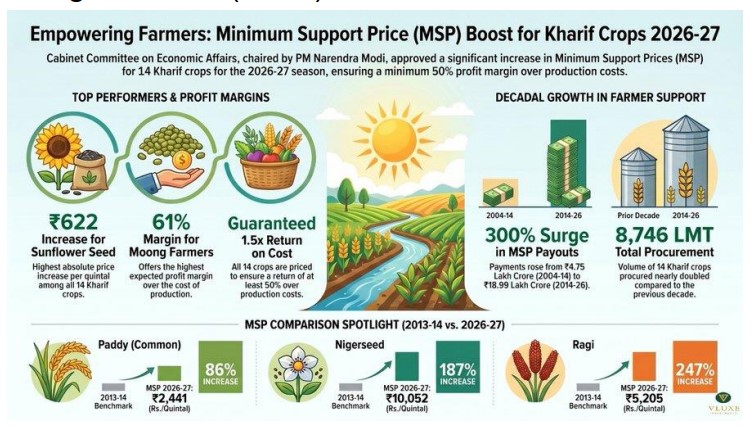
Madhya Pradesh Chief Minister Mohan Yadav announced in the State Assembly that the government plans to extend the Bhavantar Bhugtan Yojana to mustard farmers. This strategic move aims to provide price security to approximately 80 lakh farmers by compensating them for the volatility in market prices compared to government-mandated rates. Key Highlights of the Policy Extension • Price Deficiency Payment: The scheme compensates farmers for the \'difference\' (Bhavantar) between the Minimum Support Price (MSP) and the actual market price or a \'modal rate,\' ensuring they do not suffer during market crashes. • Broadening Agricultural Support: Originally focused on soybean and millets, the inclusion of mustard—a key Rabi crop—aims to stabilize income for a massive base of 80 lakh oilseed growers. • Direct Benefit Transfer (DBT): The compensation amount is credited directly into the Aadhaar-linked bank accounts of registered farmers, minimizing leakage and administrative delays. • Reduction in Procurement Logistics: Unlike traditional procurement where the government buys and stores the physical grain, this scheme allows farmers to sell in the open market, reducing state costs for warehousing and transportation. • Market Integration: Farmers are required to sell their produce only through registered Mandis (APMCs) during a specific window to be eligible for the price difference payment. • Political Context: The announcement coincided with legislative debates over the Ladli Behna Scheme, where the current government recently increased the monthly allowance to 1,500 per month for eligible women. Definitions of Key Terms • Bhavantar (Price Difference): The gap between the Minimum Support Price (MSP) set by the Centre and the average market price (Modal Rate). • Modal Rate: The average market price of a particular crop in the major mandis of the state and neighboring states over a specific period. • Minimum Support Price (MSP): The floor price at which the government promises to buy crops from farmers, designed to insure them against any sharp fall in farm prices. • Direct Benefit Transfer (DBT): A mechanism to transfer subsidies and benefits directly into the bank accounts of beneficiaries using their unique Aadhaar identification. Constitutional and Legal Provisions • Article 38 (DPSP): Mandates the State to promote the welfare of the people by securing a social order in which justice—social, economic, and political—shall inform all institutions of national life. • Seventh Schedule: \'Agriculture\' is a State Subject (Entry 14, List II), giving State governments the primary authority to design and implement price support schemes like Bhavantar. • National Food Security Act (NFSA), 2013: While primarily about subsidized food grains, it provides the broader legal context for state interventions in agricultural pricing and farmer welfare. Additional Important Key Points • Soybean Foundation: Madhya Pradesh is known as the \'Soybean Bowl\' of India; the success of Bhavantar in this sector has served as a pilot for its extension to mustard. • Ladli Behna Scheme Updates: The scheme for women between 21 and 60 years (family income < 2.5 lakh/year) has seen its monthly allowance rise from 1,000 to 1,500, though new registrations are currently on hold. • Impact on Crop Diversification: By providing price security for oilseeds like mustard, the government encourages farmers to move away from water-intensive monocropping of wheat or paddy. Conclusion and UPSC Relevance The extension of the Bhavantar scheme reflects a shift from \'physical procurement\' to \'income support\' models in Indian agriculture. For the UPSC Civil Services Exam, this topic is essential for GS Paper III (Agriculture & Economy). It highlights critical issues such as \'Issues related to Direct and Indirect Farm Subsidies,\' \'MSP and its Alternatives,\' and \'Buffer Stocks and Food Security.\' Understanding this scheme is vital for evaluating the efficiency of DBT versus physical MSP procurement and its impact on the fiscal health of the State.


Address : 506, 3rd EYE THREE (III), Opp. Induben Khakhrawala, Girish Cold Drink Cross Road, CG Road, Navrangpura, Ahmedabad, 380009.
Mobile : 8469231587 / 9586028957
E-mail: dics.upsc@gmail.com
Address: A-306, The Landmark, Urjanagar-1, Opp. Spicy Street, Kudasan – Por Road, Kudasan, Gandhinagar – 382421
Mobile : 9723832444 / 9723932444
E-mail: dics.gnagar@gmail.com
Address: 2nd Floor, 9 Shivali Society, L&T Circle, opp. Ratri Bazar, Karelibaugh, Vadodara, 390018
Mobile : 9725692037 / 9725692054
E-mail: dics.vadodara@gmail.com
Address: 403, Raj Victoria, Opp. Pal Walkway, Near Galaxy Circle, Pal, Surat-394510
Mobile : 8401031583 / 8401031587
E-mail: dics.surat@gmail.com
Address: 303,305 K 158 Complex Above Magson, Sindhubhavan Road Ahmedabad-380059
Mobile : 9974751177 / 8469231587
E-mail: dicssbr@gmail.com
Address: 57/17, 2nd Floor, Old Rajinder Nagar Market, Bada Bazaar Marg, Delhi-60
Mobile : 9104830862 / 9104830865
E-mail: dics.newdelhi@gmail.com