



Ahmedabad
(Head Office)Address : 506, 3rd EYE THREE (III), Opp. Induben Khakhrawala, Girish Cold Drink Cross Road, CG Road, Navrangpura, Ahmedabad, 380009.
Mobile : 8469231587 / 9586028957
E-mail: dics.upsc@gmail.com

Key Highlights & Summary
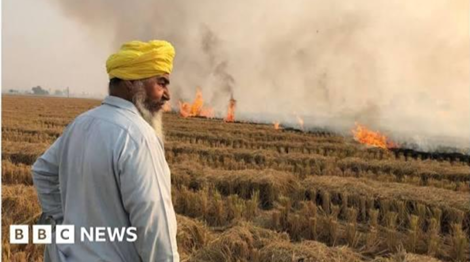
• Root Causes: Stubble burning in Punjab and Haryana is driven by the post-2009 shift in paddy harvesting timelines, leaving a narrow 10 to 15 day window before wheat sowing.
• Policy Unintended Consequences: The Punjab Preservation of Sub-Soil Water Act, 2009 delayed paddy transplantation to conserve groundwater, unintentionally forcing late harvests that coincide with winter smog conditions.
• Economic Distortion: High state procurement rates for paddy (87% in Punjab, 74% in Haryana) and free agricultural power disincentivize farmers from diversifying into alternate crops.
• Residue Management Hurdles: In-situ mechanisms (Happy Seeders/Super Seeders) and exsitu bio-energy solutions face low adoption due to high capital costs and hiring expenses for heavy machinery.
• State Interventions: Punjab relies heavily on in-situ machinery, whereas Haryana employs direct financial incentives (Rs 1,000 to Rs 7,000 per acre) for crop residue management and crop diversification.
• Measurement Discrepancies: Standard polar satellite monitoring (MODIS/VIIRS) underestimates evening fires, whereas geostationary satellite data indicates a more gradual 30% reduction in burned land area.
Essential Definitions
• Stubble Burning: The deliberate setting on fire of leftover crop straw/residue after harvesting grains like paddy to quickly clear fields for the next cropping cycle.
• In-Situ Crop Residue Management: On-farm agricultural practices that incorporate crop residue back into the soil using specialized machinery like Happy Seeders, Super Seeders, and Rotavators.
• Ex-Situ Crop Residue Management: The collection and removal of crop residue from fields for utilization in off-site commercial activities, such as bio-ethanol production, compressed biogas (CBG), or power generation.
• POLAR vs. Geostationary Satellites: Polar satellites orbit north-to-south observing fixed locations at specific times daily, whereas geostationary satellites orbit at the same speed as Earth\'s rotation, providing continuous real-time monitoring.
Legal and Constitutional Framework
• Article 21 (Constitution of India): Protects the fundamental right to clean air and a healthy environment as an integral aspect of the Right to Life.
• Article 48A (Constitution of India): Mandates the State to protect and improve the environment and safeguard forests and wildlife.
• Commission for Air Quality Management (CAQM) Act, 2021: Establishes a statutory commission for consolidated air quality management, monitoring, and enforcement across the National Capital Region and adjoining areas.
• Punjab Preservation of Sub-Soil Water Act, 2009: Prohibits early paddy nursery sowing and transplantation before specified June dates to protect groundwater resources.
Conclusion Solving stubble burning requires moving beyond punitive approaches toward structural agricultural reforms. A sustainable resolution demands aligning environmental legislation with long-term crop diversification incentives, expanding financial support for residue management, and deploying dual polar-geostationary satellite monitoring systems.
UPSC Relevance
• GS Paper II: Government policies and interventions for development in various sectors; Statutory and regulatory bodies (CAQM, CPCB).
• GS Paper III: Environmental pollution and degradation (Air Pollution, Stubble Burning); Issues related to direct and indirect farm subsidies, MSP, and crop diversification; Water resource management.


Address : 506, 3rd EYE THREE (III), Opp. Induben Khakhrawala, Girish Cold Drink Cross Road, CG Road, Navrangpura, Ahmedabad, 380009.
Mobile : 8469231587 / 9586028957
E-mail: dics.upsc@gmail.com
Address: A-306, The Landmark, Urjanagar-1, Opp. Spicy Street, Kudasan – Por Road, Kudasan, Gandhinagar – 382421
Mobile : 9723832444 / 9723932444
E-mail: dics.gnagar@gmail.com
Address: Tithi Commercial Complex, 401/402 Productivity Road, Opp. Productivity House, Alkapuri, Vadodara, Gujarat – 390007
Mobile : 9725692037 / 9725692054
E-mail: dics.vadodara@gmail.com
Address: 403, Raj Victoria, Opp. Pal Walkway, Near Galaxy Circle, Pal, Surat-394510
Mobile : 8401031583 / 8401031587
E-mail: dics.surat@gmail.com
Address: 303,305 K 158 Complex Above Magson, Sindhubhavan Road Ahmedabad-380059
Mobile : 9974751177 / 8469231587
E-mail: dicssbr@gmail.com
Address: 57/17, 2nd Floor, Old Rajinder Nagar Market, Bada Bazaar Marg, Delhi-60
Mobile : 9104830862 / 9104830865
E-mail: dics.newdelhi@gmail.com