




Ahmedabad
(Head Office)Address : 506, 3rd EYE THREE (III), Opp. Induben Khakhrawala, Girish Cold Drink Cross Road, CG Road, Navrangpura, Ahmedabad, 380009.
Mobile : 8469231587 / 9586028957
E-mail: dics.upsc@gmail.com

Key Highlights & Summary
• Veteran diplomat Tommy Koh reaffirmed that the United Nations Convention on the Law of the Sea (UNCLOS) remains the fundamental \'constitution of the oceans,\' guiding a rules-based global order over maritime spaces.
• With 172 state parties, UNCLOS enjoys near-universal adherence; even non-ratifying nations like the United States recognize its codified principles as authoritative customary international law.
• Although Iran is not a formal party to UNCLOS, the doctrine of transit passage through international straits, such as the Strait of Hormuz, has evolved into customary international law that binds all sovereign states.
• During the UNCLOS III negotiations in 1982, the primary diplomatic deadlock involved Part XI, which declared the deep seabed the \'common heritage of mankind\'—a framework initial United States administrations opposed over commercial seabed mining norms.
• The growing operational threat of \'dark fleet\' vessels—ships operating without active AIS transponders or clear registry— presents fresh challenges to high seas enforcement, requiring regulation through the International Maritime Organization (IMO).
• Geopolitical friction in regions like the South China Sea highlights that UNCLOS remains the primary legal instrument for resolving Exclusive Economic Zone (EEZ) and continental shelf boundary disputes.
Essential Definitions
• UNCLOS III: The Third United Nations Conference on the Law of the Sea (1973–1982), which drafted the comprehensive international legal treaty governing maritime zones, navigational rights, and marine resources.
• Transit Passage Regime: An established rule under international maritime law permitting all ships and aircraft, including military vessels, continuous and expeditious transit through straits used for international navigation.
• Common Heritage of Mankind: A foundational principle under UNCLOS Part XI establishing that international seabed areas beyond national jurisdiction belong to humanity as a whole and cannot be unilaterally claimed or exploited.
Legal and Constitutional Framework
• UNCLOS, 1982 (Part XI): Regulates exploration and exploitation of mineral resources in the international seabed area, administered by the International Seabed Authority (ISA).
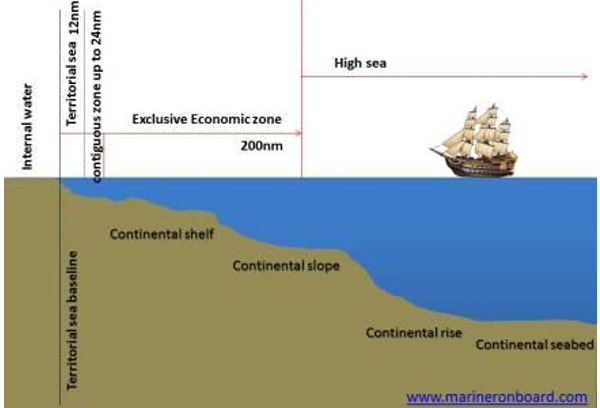
• UNCLOS, 1982 (Part V): Establishes the regime of the Exclusive Economic Zone (EEZ), extending up to 200 nautical miles, conferring sovereign rights over natural resources to coastal states while preserving freedoms of navigation.
• Territorial Waters and Maritime Zones Act, 1976: India\'s domestic statutory framework defining its territorial waters, contiguous zone, EEZ, and continental shelf in alignment with international maritime conventions.
• Article 51(c) of the Indian Constitution: Directs the State to foster respect for international law and treaty obligations in the dealings of organized peoples with one another.
Conclusion Despite regional conflicts and emerging maritime challenges like grey-market shipping fleets, UNCLOS remains the indispensable legal framework for ocean governance. Maintaining freedom of navigation and resolving EEZ overlapping claims through multilateral institutional compliance is crucial for maintaining global supply chain stability and international maritime security.
UPSC Relevance
• GS Paper II: Important International institutions, agencies, and fora—their structure, mandate; Bilateral, regional, and global groupings and agreements involving India and affecting India’s interests.
• GS Paper III: Security challenges and their management in maritime domains; Infrastructure: Ports and Maritime Trade; Conservation and ocean resource management.
• Prelims Focus: Division of maritime zones under UNCLOS (Territorial Sea, Contiguous Zone, EEZ, High Seas), ISA mandate, transit passage vs innocent passage rights, and provisions of India\'s Maritime Zones Act 1976.


Address : 506, 3rd EYE THREE (III), Opp. Induben Khakhrawala, Girish Cold Drink Cross Road, CG Road, Navrangpura, Ahmedabad, 380009.
Mobile : 8469231587 / 9586028957
E-mail: dics.upsc@gmail.com
Address: A-306, The Landmark, Urjanagar-1, Opp. Spicy Street, Kudasan – Por Road, Kudasan, Gandhinagar – 382421
Mobile : 9723832444 / 9723932444
E-mail: dics.gnagar@gmail.com
Address: 2nd Floor, 9 Shivali Society, L&T Circle, opp. Ratri Bazar, Karelibaugh, Vadodara, 390018
Mobile : 9725692037 / 9725692054
E-mail: dics.vadodara@gmail.com
Address: 403, Raj Victoria, Opp. Pal Walkway, Near Galaxy Circle, Pal, Surat-394510
Mobile : 8401031583 / 8401031587
E-mail: dics.surat@gmail.com
Address: 303,305 K 158 Complex Above Magson, Sindhubhavan Road Ahmedabad-380059
Mobile : 9974751177 / 8469231587
E-mail: dicssbr@gmail.com
Address: 57/17, 2nd Floor, Old Rajinder Nagar Market, Bada Bazaar Marg, Delhi-60
Mobile : 9104830862 / 9104830865
E-mail: dics.newdelhi@gmail.com