




Ahmedabad
(Head Office)Address : 506, 3rd EYE THREE (III), Opp. Induben Khakhrawala, Girish Cold Drink Cross Road, CG Road, Navrangpura, Ahmedabad, 380009.
Mobile : 8469231587 / 9586028957
E-mail: dics.upsc@gmail.com

Key Highlights & Summary
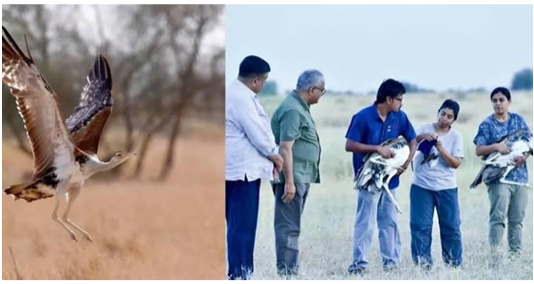
• Milestone Rewilding Initiative: Two captive-bred male Great Indian Bustards (GIBs) were released into the wild for the first time at Desert National Park in Rajasthan under Project GIB, executed jointly by the Centre, Wildlife Institute of India (WII), and state governments.
• Critical Population Decline: From an estimated 1,260–1,400 individuals in the 1970s, the wild GIB population has plummeted to around 150 globally, with approximately 130 (+/-20) concentrated in Rajasthan and small populations facing local extinction across Gujarat, Maharashtra, Karnataka, Telangana, and Andhra Pradesh.
• Threats Driving Extinction: Key drivers of decline include habitat loss from land conversion, hunting, limestone mining, and collisions with high-voltage renewable energy powerlines, exacerbated by the bird poor frontal vision and heavy body weight.
• Captive Breeding Success: Initiated in 2019, artificial incubation of wild-collected eggs at centers in Sam and Ramdevra has yielded 98 birds so far, providing the stock for gradual softrelease and rewilding programs.
• Grassland Ecosystem Vulnerability: Unlike forests, open natural ecosystems like savannas and grasslands lack public recognition as protected habitats, leaving them vulnerable to degradation and misplaced afforestation initiatives that alter bustard habitats.
• Supreme Court Mandates: Accepting expert recommendations, the apex court ordered the undergrounding of 80 km of powerlines in priority habitats in Rajasthan and Gujarat, alongside creating dedicated powerline corridors for rerouted lines.
Essential Definitions
• Rewilding: The ecological practice of restoring natural processes and reintroducing captivebred or displaced animal species back into wild natural habitats.
• Soft Release: A conservation methodology where captive-reared animals are acclimatized in protected natural enclosures at the release site prior to full liberation into the wild.
• Open Natural Ecosystems (ONEs): Non-forested terrestrial biomes, including grasslands, shrublands, and savannas, that support specialized, endemic fauna such as the Great Indian Bustard.
Legal and Constitutional Framework
• Wildlife Protection Act, 1972: The Great Indian Bustard is listed under Schedule I, providing it the highest degree of legal protection against hunting and habitat destruction.
• IUCN Red List & CITES Status: Categorized as Critically Endangered on the IUCN Red List and listed under Appendix I of CITES and the Convention on Migratory Species (CMS).
• Constitutional Directives: Article 48A mandates the State to protect and improve the environment, while Article 51A(g) places a fundamental duty on citizens to protect wildlife and have compassion for living creatures.
Conclusion The experimental rewilding of the Great Indian Bustard represents a vital step toward saving India flagship grassland species from the brink of extinction. However, long-term survival depends on securing grassland ecosystems, enforcing powerline undergrounding, and balancing green energy expansion with biodiversity conservation.
UPSC Relevance
• GS Paper III (Environment & Ecology): Biodiversity conservation, species recovery programs (Project GIB), threats to endemic species, and challenges of captive breeding and rewilding.
• GS Paper III (Infrastructure & Conservation Conflict): Balancing renewable energy infrastructure development with environmental impact assessments and wildlife protection mandates.


Address : 506, 3rd EYE THREE (III), Opp. Induben Khakhrawala, Girish Cold Drink Cross Road, CG Road, Navrangpura, Ahmedabad, 380009.
Mobile : 8469231587 / 9586028957
E-mail: dics.upsc@gmail.com
Address: A-306, The Landmark, Urjanagar-1, Opp. Spicy Street, Kudasan – Por Road, Kudasan, Gandhinagar – 382421
Mobile : 9723832444 / 9723932444
E-mail: dics.gnagar@gmail.com
Address: Tithi Commercial Complex, 401/402 Productivity Road, Opp. Productivity House, Alkapuri, Vadodara, Gujarat – 390007
Mobile : 9725692037 / 9725692054
E-mail: dics.vadodara@gmail.com
Address: 403, Raj Victoria, Opp. Pal Walkway, Near Galaxy Circle, Pal, Surat-394510
Mobile : 8401031583 / 8401031587
E-mail: dics.surat@gmail.com
Address: 303,305 K 158 Complex Above Magson, Sindhubhavan Road Ahmedabad-380059
Mobile : 9974751177 / 8469231587
E-mail: dicssbr@gmail.com
Address: 57/17, 2nd Floor, Old Rajinder Nagar Market, Bada Bazaar Marg, Delhi-60
Mobile : 9104830862 / 9104830865
E-mail: dics.newdelhi@gmail.com