



Ahmedabad
(Head Office)Address : 506, 3rd EYE THREE (III), Opp. Induben Khakhrawala, Girish Cold Drink Cross Road, CG Road, Navrangpura, Ahmedabad, 380009.
Mobile : 8469231587 / 9586028957
E-mail: dics.upsc@gmail.com

Key Highlights & Summary
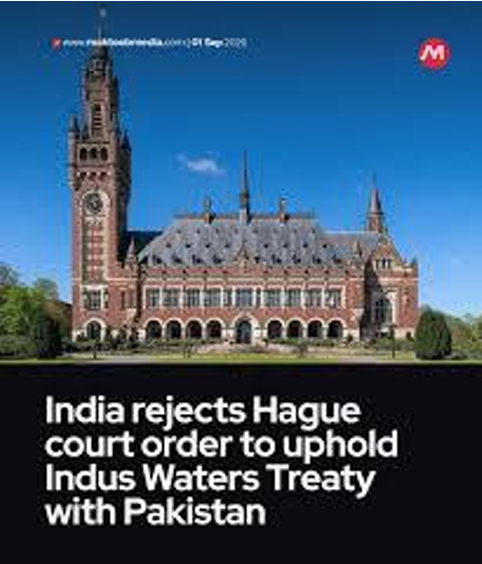
• PCA Order Rejection: India firmly rejected two latest orders by the Permanent Court of Arbitration (PCA) in The Hague, which declared that India’s decision to put the Indus Waters Treaty (IWT) in \'abeyance\' was impermissible and directed India to halt construction on the Ratle Hydroelectric Project.
• Procedural Breach Allegation: New Delhi has boycotted PCA proceedings for four years, maintaining that the court was constituted by the World Bank in direct violation of IWT provisions while a Neutral Expert process was simultaneously active. • Three-Tier Dispute Resolution: The 1960 IWT establishes a strict hierarchy for resolving issues: any \'question\' goes to the Permanent Indus Commission; unresolved issues become a \'difference\' referred to a Neutral Expert; and only specific unresolved matters escalate to a Court of Arbitration.
• Enforceability Deficit: The PCA lacks structural enforcement mechanisms to execute its awards against India, though Pakistan is expected to leverage the rulings diplomatically at international platforms like the UN Security Council.
• Strategic Shift by India: India considers the IWT practically defunct, holding that abeyance prevents unilateral termination while disengaging from parallel resolution mechanisms and halting direct hydrological data exchanges via the Permanent Indus Commission.
• Infrastructure Acceleration: India is expediting eight power projects worth Rs 50,000 crore in Jammu & Kashmir on the Western Rivers (Indus, Jhelum, Chenab) to fully utilize its treatypermitted non-consumptive water rights.
Essential Definitions
• Indus Waters Treaty (IWT), 1960: A waterdistribution treaty brokered by the World Bank dividing the Indus system, allocating Eastern Rivers (Sutlej, Beas, Ravi) to India and Western Rivers (Indus, Jhelum, Chenab) primarily to Pakistan.
• Abeyance: A state of temporary disuse or suspension of legal operation, invoked by India regarding the treaty framework. • Neutral Expert: An independent technical expert appointed under the IWT framework to adjudicate specific technical \'differences\' between the two nations.
Legal and Constitutional Framework
• Vienna Convention on the Law of Treaties (VCLT), 1969: Governs treaty interpretation, suspension, and material breach rules under customary international law.
• Article 253 of the Indian Constitution: Empowers Parliament to make laws executing international treaties, agreements, or conventions.
• Entry 56, Union List (Seventh Schedule): Grants the Central Government authority over the regulation and development of inter-State rivers and river valleys.
• Customary International Water Law: Principles governing non-navigational uses of international watercourses, balancing equitable utilization with territorial sovereignty.
Conclusion India’s rejection of the Hague Court orders reflects a decisive shift toward bilateral realism in transboundary water management. By focusing on domestic infrastructure completion along the Western Rivers, India aims to maximize its legitimate water entitlements while resisting external judicial interventions outside treaty parameters.
UPSC Relevance
• GS Paper II (International Relations): Highly relevant for questions on India-Pakistan bilateral relations, international dispute resolution bodies, treaty compliance, and transboundary water diplomacy.
• GS Paper III (Infrastructure & Security): Important for analyzing hydroelectric infrastructure projects in Jammu & Kashmir, energy security, and regional resource management.


Address : 506, 3rd EYE THREE (III), Opp. Induben Khakhrawala, Girish Cold Drink Cross Road, CG Road, Navrangpura, Ahmedabad, 380009.
Mobile : 8469231587 / 9586028957
E-mail: dics.upsc@gmail.com
Address: A-306, The Landmark, Urjanagar-1, Opp. Spicy Street, Kudasan – Por Road, Kudasan, Gandhinagar – 382421
Mobile : 9723832444 / 9723932444
E-mail: dics.gnagar@gmail.com
Address: Tithi Commercial Complex, 401/402 Productivity Road, Opp. Productivity House, Alkapuri, Vadodara, Gujarat – 390007
Mobile : 9725692037 / 9725692054
E-mail: dics.vadodara@gmail.com
Address: 403, Raj Victoria, Opp. Pal Walkway, Near Galaxy Circle, Pal, Surat-394510
Mobile : 8401031583 / 8401031587
E-mail: dics.surat@gmail.com
Address: 303,305 K 158 Complex Above Magson, Sindhubhavan Road Ahmedabad-380059
Mobile : 9974751177 / 8469231587
E-mail: dicssbr@gmail.com
Address: 57/17, 2nd Floor, Old Rajinder Nagar Market, Bada Bazaar Marg, Delhi-60
Mobile : 9104830862 / 9104830865
E-mail: dics.newdelhi@gmail.com