Ahmedabad
(Head Office)Address : 506, 3rd EYE THREE (III), Opp. Induben Khakhrawala, Girish Cold Drink Cross Road, CG Road, Navrangpura, Ahmedabad, 380009.
Mobile : 8469231587 / 9586028957
E-mail: dics.upsc@gmail.com

Key Highlights & Summary
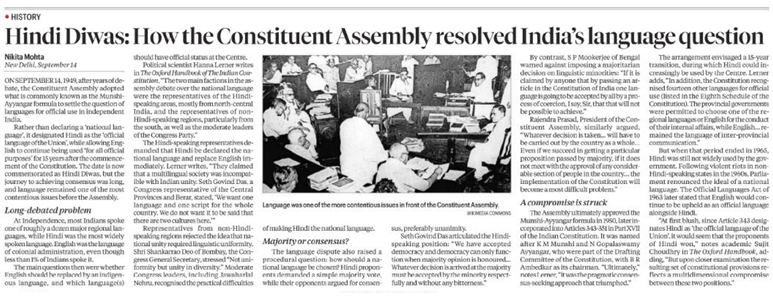
• Adoption of the Munshi-Ayyangar Formula: On September 14, 1949, the Constituent Assembly adopted a pragmatic compromise formulated by K.M. Munshi and N. Gopalaswamy Ayyangar, steering clear of declaring a single \'national language\'.
• Designation as Official Language: Hindi in Devanagari script was designated as the \'official language of the Union,\' while English was permitted to continue for all official Union purposes for an initial period of 15 years.
• Competing Factions in the Assembly: Debates pitted pro-Hindi advocates like Seth Govind Das (demanding immediate replacement of English and one national script) against representatives from non-Hindi regions like S.P. Mookerjee and Shankarrao Deo, who cautioned against majoritarian coercion.
• Consensus Over Majoritarianism: Assembly Leaders including Jawaharlal Nehru and Assembly President Rajendra Prasad emphasized that lasting constitutional decisions required broad national consensus rather than simple majority votes.
• Provincial Autonomy and Regional Languages: The compromise allowed provincial governments to select regional languages or English for internal administration and interprovincial communication, laying the groundwork for the Eighth Schedule (initially featuring 14 languages).
• Post-1965 Legislative Continuity: As the 15-year transitional period ended in 1965 amidst anti-Hindi protests, the Official Languages Act of 1963 ensured the continued coofficial status of English alongside Hindi. Essential Definitions
• Official Language: The language designated by a sovereign state for legislative, executive, and judicial administration, distinct from a single mandated \'national language\'.
• Munshi-Ayyangar Formula: The constitutional compromise designed by Drafting Committee members K.M. Munshi and N. Gopalaswamy Ayyangar balancing Hindi’s official status with English’s transitional usage.
• Eighth Schedule: A list in the Indian Constitution recognizing official regional languages to promote cultural pluralism and administrative representation.
Legal and Constitutional Framework
• Article 343 of the Indian Constitution: Declares Hindi in Devanagari script as the official language of the Union and provides for the continued use of English for official purposes.
• Articles 345 to 347: Empower State Legislatures to adopt one or more regional languages or English for official state administrative purposes.
• Official Languages Act, 1963: Statutory legislation providing for the continued use of English for Union administrative work and inter-state communication alongside Hindi beyond May 26, 1965.
Conclusion The Munshi-Ayyangar compromise reflects the Constituent Assembly’s commitment to accommodation and unity in diversity. By distinguishing official administrative functions from national identity, India established a flexible linguistic framework that safeguards federalism and linguistic pluralism.
UPSC Relevance
• GS Paper II: Polity and Governance (Constituent Assembly debates, official language provisions, federal structure, Eighth Schedule, and protection of linguistic minorities).
• GS Paper I: Indian History & Culture (Post-independence consolidation, linguistic reorganization, and political history of modern India).


Address : 506, 3rd EYE THREE (III), Opp. Induben Khakhrawala, Girish Cold Drink Cross Road, CG Road, Navrangpura, Ahmedabad, 380009.
Mobile : 8469231587 / 9586028957
E-mail: dics.upsc@gmail.com
Address: A-306, The Landmark, Urjanagar-1, Opp. Spicy Street, Kudasan – Por Road, Kudasan, Gandhinagar – 382421
Mobile : 9723832444 / 9723932444
E-mail: dics.gnagar@gmail.com
Address: 2nd Floor, 9 Shivali Society, L&T Circle, opp. Ratri Bazar, Karelibaugh, Vadodara, 390018
Mobile : 9725692037 / 9725692054
E-mail: dics.vadodara@gmail.com
Address: 403, Raj Victoria, Opp. Pal Walkway, Near Galaxy Circle, Pal, Surat-394510
Mobile : 8401031583 / 8401031587
E-mail: dics.surat@gmail.com
Address: 303,305 K 158 Complex Above Magson, Sindhubhavan Road Ahmedabad-380059
Mobile : 9974751177 / 8469231587
E-mail: dicssbr@gmail.com
Address: 57/17, 2nd Floor, Old Rajinder Nagar Market, Bada Bazaar Marg, Delhi-60
Mobile : 9104830862 / 9104830865
E-mail: dics.newdelhi@gmail.com