



Ahmedabad
(Head Office)Address : 506, 3rd EYE THREE (III), Opp. Induben Khakhrawala, Girish Cold Drink Cross Road, CG Road, Navrangpura, Ahmedabad, 380009.
Mobile : 8469231587 / 9586028957
E-mail: dics.upsc@gmail.com

UPSC Relevance GS Paper III (Indian Economy, Mobilization of Resources, and Capital Market Reforms).
Why in News
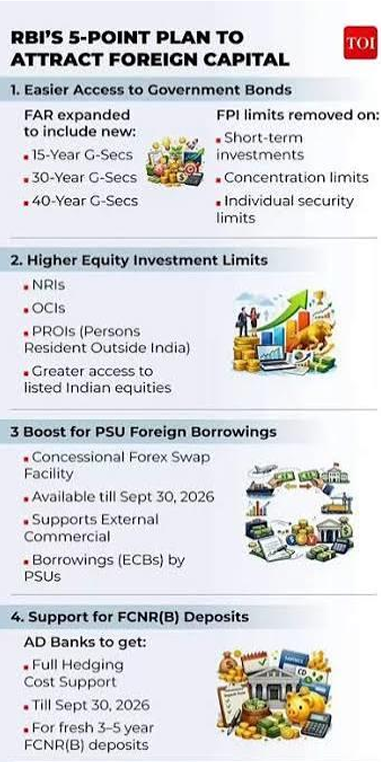
Union Finance Minister Nirmala Sitharaman acknowledged growing anxiety among retail investors over stock valuations, capital gains tax, and Foreign Portfolio Investor (FPI) outflows, emphasizing stakeholder consultations ahead of the Union Budget.
Background • Market Dynamics: Indian stock markets witnessed strong FPI inflows during FY 2023–24 under the existing capital gains framework. However, recent quarters recorded net FPI outflows amid global headwinds and valuation concerns.
• Capital Need: Sustaining India GDP growth rate at 7% or above requires robust capital formation, relying on both domestic retail participation and global foreign capital.
• Market Balance: Beyond corporate bond market deepening, equity markets play an indispensable role in financing long-term economic expansion.
Impact & Measures
• Implications & Challenges: Heightened market volatility, high equity valuations, and foreign capital outflows pose risks to market stability. Over-reliance on tax sops can distort market fundamentals, which should ideally be driven by corporate earnings and economic strength.
• Government Intent: Promised pre-budget consultations to review stakeholder concerns without creating policy bias in favor of foreign investors over domestic (rupee) investors.
• Way Forward: Promoting balanced tax policies, enhancing market transparency, deepening corporate bond markets, and maintaining macro-economic stability to attract sustainable, long-term capital.
Essential Definitions
• Foreign Portfolio Investment (FPI): Investments in foreign financial assets such as stocks and bonds without direct managerial control over companies.
• Capital Gains Tax: A tax levied on the profit realized from the sale of non-inventory assets like stocks, real estate, or bonds.
Legal and Constitutional Framework
• SEBI Act, 1992: Grants statutory powers to the Securities and Exchange Board of India to protect investor interests and regulate capital markets.
• Income Tax Act, 1961: Governs the taxation regime for Short-Term (STCG) and Long-Term Capital Gains (LTCG) on equity investments.
• Constitutional Provision: Article 265 mandates that no tax shall be levied or collected except by authority of law.
Conclusion A balanced approach that addresses investor grievances while preserving core market fundamentals is vital. Ensuring parity between domestic retail investors and foreign portfolio capital will foster a resilient, transparent, and growth-oriented financial ecosystem.


Address : 506, 3rd EYE THREE (III), Opp. Induben Khakhrawala, Girish Cold Drink Cross Road, CG Road, Navrangpura, Ahmedabad, 380009.
Mobile : 8469231587 / 9586028957
E-mail: dics.upsc@gmail.com
Address: A-306, The Landmark, Urjanagar-1, Opp. Spicy Street, Kudasan – Por Road, Kudasan, Gandhinagar – 382421
Mobile : 9723832444 / 9723932444
E-mail: dics.gnagar@gmail.com
Address: Tithi Commercial Complex, 401/402 Productivity Road, Opp. Productivity House, Alkapuri, Vadodara, Gujarat – 390007
Mobile : 9725692037 / 9725692054
E-mail: dics.vadodara@gmail.com
Address: 403, Raj Victoria, Opp. Pal Walkway, Near Galaxy Circle, Pal, Surat-394510
Mobile : 8401031583 / 8401031587
E-mail: dics.surat@gmail.com
Address: 303,305 K 158 Complex Above Magson, Sindhubhavan Road Ahmedabad-380059
Mobile : 9974751177 / 8469231587
E-mail: dicssbr@gmail.com
Address: 57/17, 2nd Floor, Old Rajinder Nagar Market, Bada Bazaar Marg, Delhi-60
Mobile : 9104830862 / 9104830865
E-mail: dics.newdelhi@gmail.com