Ahmedabad
(Head Office)Address : 506, 3rd EYE THREE (III), Opp. Induben Khakhrawala, Girish Cold Drink Cross Road, CG Road, Navrangpura, Ahmedabad, 380009.
Mobile : 8469231587 / 9586028957
E-mail: dics.upsc@gmail.com

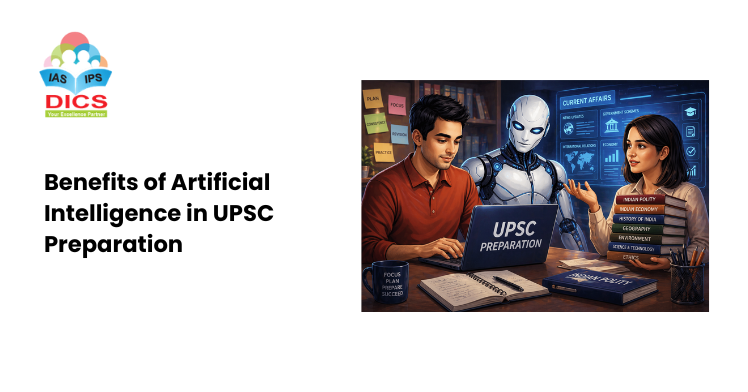
It is not the number of hours you spend that is important in UPSC preparation. It is all about spending those hours as best as possible. The enormous syllabus, the unstable and dynamic current affairs, and the intense competition frequently leave aspirants perplexed about where to study, how to stay consistent, and how to measure their progress.
Artificial Intelligence (AI) is a field that is intervening as a powerful tool in the preparation for the UPSC. It allows applicants to use their study hours more efficiently, eliminate time wastage, and focus on what matters. When used properly, AI does not replace hard work. It only multiplies what you obtain with it.
Artificial Intelligence is not taking over preparation. It is making the whole process sharper. Instead of just working harder, aspirants can now work smarter with clearer direction, better organization, and clearer signs of improvement.

AI creates study plans that match your personal needs by considering your performance in exams, the precision of your answers, and your good grades. It helps you avoid wasting more time on issues you are familiar with and refocuses your attention on what needs to be done. This specialized approach increases the efficiency and keeps your preparation moving on.
AI makes sure doubts do not hold back your learning. It gives quick explanations and breaks difficult topics into easy-to-understand parts. This helps a lot in subjects that need clear thinking and connections between different ideas.
Dealing with the large amount of UPSC material gets simpler with AI summarization tools. It turns long chapters, reports, and current affairs into short, easy-to-revise formats. This allows aspirants to revise more effectively while still retaining the important points.
AI tools help aspirants improve their answer writing by providing immediate feedback and suggestions. It points out problems in structure, content depth, and the way the answer is presented, which helps them keep getting better without waiting. This speeds up Mains preparation significantly.
AI follows your preparation with detailed reports that show performance patterns. It spots weaker areas, watches how you improve over weeks and months, and helps you make smart changes for stronger outcomes.
AI-driven mock tests change their difficulty level according to how you are doing. This guarantees that you are training at the correct level, makes you more accurate, makes you more confident, and puts you in the real exam conditions.
AI enhances revision by applying techniques such as spaced repetition and digital flashcards. These methods enhance long-term memory and help aspirants recall information quickly when they appear for the exam.
AI assists in creating daily study timetables, deciding what to do first, and keeping a steady routine. This keeps preparation organized and connected to the bigger goals you have set.
AI links recent events to the fixed parts of the syllabus. This helps aspirants build analytical thinking and raise the quality of their answers in both Prelims and Mains.
AI tools provide continuous assistance with learning, allowing aspirants to learn at any time without relying on a set schedule of classes. This type of flexibility is particularly effective for individuals who study independently or are employed.
AI can greatly improve UPSC preparation, but relying on it without thinking can leave important gaps that affect final results. The exam requires real depth, sound judgment, and a proper understanding. These are the areas where AI still falls short.
AI can explain things, though its explanations tend to be straightforward. The UPSC requires interrelationships, critical thinking, and interdisciplinary knowledge. Depending on AI summaries, too much may lead to surface-level preparation, especially in such subjects as policy, Ethics, and Essay.
UPSC Mains is not just about collecting facts. It is about analysis. AI can produce well-organized answers, but it cannot create your own personal views, clear arguments, or fresh perspectives. These elements matter a lot for high scores.
AI simplifies studying, but this simplicity can become a weakness. Aspirants may also start relying on prepared notes and answers rather than actively working with the content. This lowers how much they remember and weakens real understanding.
Even though AI provides fast feedback, its comments are often quite standard. It can miss finer points such as original thinking, depth of reasoning, or what examiners actually expect. Experienced mentors usually catch these details better.
AI-generated content is not always accurate or applicable to the specific scenario. UPSC requires specific information, and relying on AI results without their verification may lead to errors or misunderstandings of points.
Many UPSC aspirants fall short not because they don’t work hard, but because their preparation lacks direction and structure. Without the right strategy, consistent evaluation, and expert guidance, efforts often lead to burnout instead of results.
That’s where DICS (Delhi Institute for Civil Services) makes the difference. We combine proven preparation methods with focused guidance, regular performance tracking, and personalized mentorship. With over a decade of experience, 3500+ students trained, and 330+ selections, our approach is built on results—not guesswork.
If you’re searching for effective UPSC coaching in Gujarat that offers clarity, consistency, and a strategic edge, DICS is built to support your journey.


Address : 506, 3rd EYE THREE (III), Opp. Induben Khakhrawala, Girish Cold Drink Cross Road, CG Road, Navrangpura, Ahmedabad, 380009.
Mobile : 8469231587 / 9586028957
E-mail: dics.upsc@gmail.com
Address: A-306, The Landmark, Urjanagar-1, Opp. Spicy Street, Kudasan – Por Road, Kudasan, Gandhinagar – 382421
Mobile : 9723832444 / 9723932444
E-mail: dics.gnagar@gmail.com
Address: Tithi Commercial Complex, 401/402 Productivity Road, Opp. Productivity House, Alkapuri, Vadodara, Gujarat – 390007
Mobile : 9725692037 / 9725692054
E-mail: dics.vadodara@gmail.com
Address: 403, Raj Victoria, Opp. Pal Walkway, Near Galaxy Circle, Pal, Surat-394510
Mobile : 8401031583 / 8401031587
E-mail: dics.surat@gmail.com
Address: 303,305 K 158 Complex Above Magson, Sindhubhavan Road Ahmedabad-380059
Mobile : 9974751177 / 8469231587
E-mail: dicssbr@gmail.com
Address: 57/17, 2nd Floor, Old Rajinder Nagar Market, Bada Bazaar Marg, Delhi-60
Mobile : 9104830862 / 9104830865
E-mail: dics.newdelhi@gmail.com