
Ahmedabad
(Head Office)Address : 506, 3rd EYE THREE (III), Opp. Induben Khakhrawala, Girish Cold Drink Cross Road, CG Road, Navrangpura, Ahmedabad, 380009.
Mobile : 8469231587 / 9586028957
E-mail: dics.upsc@gmail.com

Key Highlights & Summary
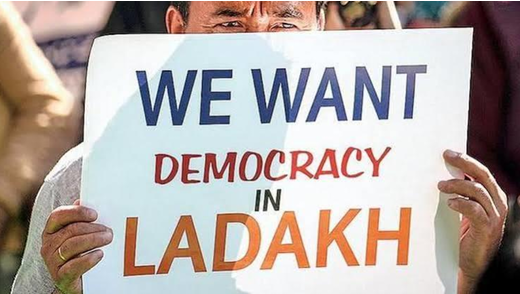
• Ladakh demand for Sixth Schedule status and the Union Home Ministry proposal for a directly elected legislative body have raised the question of whether a Union Territory can be granted such status. The Centre has proposed inserting Article 371-K in Part XXI of the Constitution (Temporary, Transitional and Special Provisions).
• Ladakh became a Union Territory without a Legislative Assembly under the Jammu and Kashmir Reorganisation Act, 2019. Local groups seek protection of language, culture and customary practices, safeguards against outsiders acquiring land, and better political representation.
• The Sixth Schedule, governed by Article 244(2) and Article 275(1), covers only Assam, Meghalaya, Tripura and Mizoram, areas that were \'Excluded\' or \'Partially Excluded\' under British rule. The Governor can create Autonomous Districts, each with a district council of a maximum of 30 members.
• The Centre is reluctant to extend the Sixth Schedule, as high autonomy could affect national security given Ladakh\'s strategic location near China. The proposed elected body may sit above the Ladakh Autonomous Hill Development Councils (LAHDCs), while retaining panchayats and district institutions.
• Key uncertainties remain, including the role of the Lieutenant Governor and the extent of the body\'s powers, particularly financial autonomy, since financial and residuary powers rest with the Union.
• The author argues that granting a sui generis model to a UT is constitutionally valid, citing the special provisions for Delhi under Articles 239AA and 239AB. In State of Rajasthan v. Union of India (1977), the Supreme Court described Indian federalism as \'Amphibian\', federal in normal times and unitary during an Emergency.
Essential Definitions
• Sui generis: A unique arrangement, tailored to a specific case and not modelled on any existing category.
• Autonomous District Council: A self-governing body in Sixth Schedule areas with legislative, judicial and financial powers over land, forests, customs and local administration.
• Union Territory: A centrally administered unit under Article 239, governed through an Administrator or Lieutenant Governor.
• Doctrine of Proportionality: Principle that State action must be balanced and suited to the objective pursued, applied here to differential governance arrangements.
• Rawlsian justice: The idea that social arrangements should give the greatest advantage to the least advantaged.
Legal and Constitutional Framework
• Article 244(2) and Article 275(1): Administration of tribal areas in Assam, Meghalaya, Tripura and Mizoram, and grants-in-aid for them.
• Fifth Schedule: Administration and control of Scheduled Areas and Scheduled Tribes in other States.
• Articles 239 to 241: Administration of Union Territories.
• Article 239A, 239AA and 239AB: Special provisions for Puducherry and the National Capital Territory of Delhi.
• Articles 371 to 371-J: Special provisions for States such as Nagaland, Assam, Manipur, Sikkim, Mizoram and Karnataka.
• Article 3 and Article 4: Parliament\'s power to reorganise States and Union Territories.
• Jammu and Kashmir Reorganisation Act, 2019: Created the UT of Ladakh without a legislature.
• Article 240: President\'s power to make regulations for certain Union Territories.
• Article 244A: Autonomous State within Assam. Conclusion Ladakh\'s case requires a balance between strategic security needs and the protection of a distinct ethno-cultural identity. An elected legislative body through Article 371-K could offer representation and local participation without weakening national integrity, but its success depends on clarity about the Lieutenant Governor\'s role, financial powers and safeguards for land and culture.
UPSC Relevance
• Prelims: Sixth Schedule, Article 244(2), Article 275(1), Articles 239AA and 239AB, Article 371 series, Autonomous District Councils, LAHDC.
• Mains GS-II: Federalism, Union Territories, special provisions for regions, Scheduled and Tribal Areas, devolution of powers.
• Mains GS-I: Regionalism, tribal identity and cultural preservation.
• Mains GS-III: Border management and internal security in strategic regions.
• Essay and Interview: Themes like \'Autonomy versus national integrity\' and \'Asymmetric federalism in India\'.


Address : 506, 3rd EYE THREE (III), Opp. Induben Khakhrawala, Girish Cold Drink Cross Road, CG Road, Navrangpura, Ahmedabad, 380009.
Mobile : 8469231587 / 9586028957
E-mail: dics.upsc@gmail.com
Address: A-306, The Landmark, Urjanagar-1, Opp. Spicy Street, Kudasan – Por Road, Kudasan, Gandhinagar – 382421
Mobile : 9723832444 / 9723932444
E-mail: dics.gnagar@gmail.com
Address: Tithi Commercial Complex, 401/402 Productivity Road, Opp. Productivity House, Alkapuri, Vadodara, Gujarat – 390007
Mobile : 9725692037 / 9725692054
E-mail: dics.vadodara@gmail.com
Address: 403, Raj Victoria, Opp. Pal Walkway, Near Galaxy Circle, Pal, Surat-394510
Mobile : 8401031583 / 8401031587
E-mail: dics.surat@gmail.com
Address: 303,305 K 158 Complex Above Magson, Sindhubhavan Road Ahmedabad-380059
Mobile : 9974751177 / 8469231587
E-mail: dicssbr@gmail.com
Address: 57/17, 2nd Floor, Old Rajinder Nagar Market, Bada Bazaar Marg, Delhi-60
Mobile : 9104830862 / 9104830865
E-mail: dics.newdelhi@gmail.com